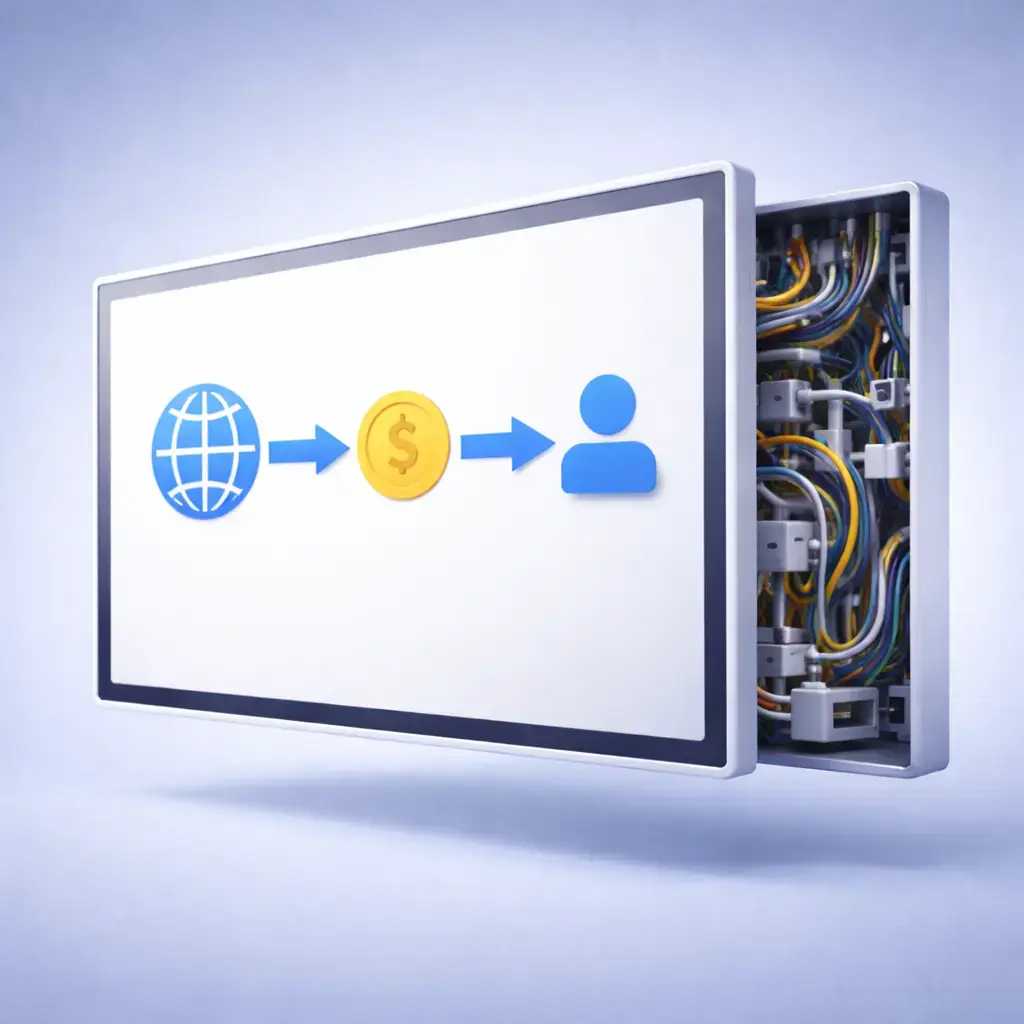








For a long time, automation in the music industry was easy to ignore. It sat in the background, handling payouts, processing tax forms, and reconciling reports. It mattered, but it didn’t define the experience. Artists rarely thought about it, and music companies didn’t treat it as a point of differentiation.
That separation is starting to blur.
Today, the systems that used to live in the back office are shaping the moments artists care about most: How quickly they can get started. How clearly they understand what they’ve earned. How reliably (and how often) they get paid. What used to be operational has become experiential, and in many cases, it’s now the difference between a music business that feels trustworthy and one that doesn’t.
For music companies—whether labels, distributors, or platforms managing royalties at scale—this shift is already underway. It came through clearly in our March 31, 2026 webinar with Music Ally, Win the Artist: Why Experience Is the New Competitive Advantage in Music. It was framed around trust, and the small, repeatable interactions that build or erode it over time.
“Artists are choosing platforms based on trust, transparency, and how they’re treated in those little moments that matter.”
Payouts sit right at the center of those moments. They are where value becomes real. And increasingly, they are where platforms are being judged.
And automation is the only way to meet those expectations at scale.
What we cover

Complexity is inevitable. Friction isn’t.
As music companies scale globally, the complexity behind those moments increases quickly. Expanding into new markets introduces new payout methods, artist tax requirements, compliance obligations, and expectations around how money should move. None of this is optional. But how it shows up to the artist is.
That’s where many systems start to break down. A payout is delayed because of a local banking rule. A tax form interrupts onboarding. A payment method works in one region but not another. Internally, these are understandable edge cases. Externally, they feel like inconsistency. And inconsistency is what erodes trust.
The challenge isn’t complexity itself. Every business operating on a global scale has complexity. The challenge is preventing that complexity from surfacing in the experience.
As Conor Cox, VP Revenue at Trolley, put it during the webinar, music platforms, labels, and distributors need to operate globally while feeling local—supporting how people expect to get paid in their region, while handling the regulatory and operational burden behind the scenes. That balance is difficult to achieve manually, which is why automation has moved from being a convenience to being a requirement. Not because it reduces effort, but because it is the only way to scale consistency.
“You want it to work like plumbing… when you turn it on, it just works.”
Expectations are changing faster than the industry
At the same time, the definition of a “good” payout experience is changing. The rise of micro-transactions, fan-to-artist payments, and more flexible earning models is reshaping expectations. Artists are no longer comparing your service to other music services. They are comparing it to every digital experience they have, many of which allow money to move instantly and transparently.
The infrastructure to support that kind of experience already exists. Other industries have been using it for years. What’s changing now is the pressure to adopt it. Once artists expect faster, clearer, more flexible payouts, anything slower begins to feel outdated. And in a market where switching costs are low, that expectation becomes a competitive force.
As Cox noted in the discussion, “Switching costs… are lower than they’ve ever been… it’s never been easier to pick up your ball and go to another court.”
This is where the idea of recipient experience starts to matter more than the mechanics of payouts themselves. The question is no longer just whether you can send money. It’s how that moment feels to the person receiving it. Whether it’s clear, predictable, and respectful—or opaque, delayed, and frustrating.
This is where trust is won or lost. Because payouts are not just financial events. They are relationship moments.
Automation should make the experience feel more human
There’s a natural tension here. As more of the artist journey becomes automated, there’s a concern that the experience becomes impersonal—that artists are interacting with systems rather than people. But in practice, the opposite tends to be true.
But framing this as a trade-off misses the point. As Dion Baez, VP of Community at SoundCloud, put it, “Technology should be in service of humans.”
The role of automation is not to replace human interaction, but to remove the friction that gets in the way of it. When payments fail, onboarding stalls, or compliance becomes manual, teams spend their time fixing problems instead of building relationships.
Automation shifts that balance. It handles the repetitive, failure-prone parts of the system so that human effort can be directed where it has the most impact.
This becomes clearer when you look across the stack. Even areas like rights management (arguably one of the most complex and operationally heavy parts of running a modern music business) are being rethought in terms of experience.
As Alice McLean, Head of Label & Artist Solutions at Believe, described, the goal isn’t to push that complexity onto artists or labels, but to make it visible, manageable, and supported. That means giving teams direct visibility into ownership, conflicts, and territories, while backing it with systems and dedicated support that reduce the need for manual intervention.
“It’s the information, it’s the insight… but it’s really the human expertise on top of that data that makes the difference.”
In practice, that balance is what matters. Systems provide the structure—surfacing the right data, automating the right workflows—but it’s the combination of automation and human expertise that allows teams to act on it effectively.
The artist doesn’t need to understand how everything works.
They need to feel like nothing is getting in their way.
The experience now lives in the back office
The broader takeaway is that automation has crossed a threshold.
As Alice McLean put it during the webinar, that shift isn’t just about better tools—it’s about combining systems with human expertise to actually make them useful in practice.
The music companies that recognize this are starting to make different decisions. They are not asking how to automate more. They are asking what to automate, what to simplify, and where human interaction matters most. They are designing systems that contain complexity rather than expose it, and in doing so, they are turning a traditionally invisible function into a point of differentiation.
Because in today’s music industry, the back office isn’t just operational infrastructure. It’s where the experience lives.
Where payouts become a competitive advantage
What’s emerging is a different way of thinking about payouts altogether. Not as a finance function, and not even purely as infrastructure, but as a core part of the product experience.
In a market where creators, contractors, and rightsholders have more choice than ever, that experience becomes a lever for retention. Artists and rightsholders gravitate toward the companies that pay them clearly, quickly, and reliably, and they leave the ones that don’t.
This is where most existing solutions start to show their limits. Many were built for finance teams, not for artists or rightsholders, optimising for control, reconciliation, and compliance.
This is exactly the challenge most payout infrastructure struggles to solve. For music companies managing royalties, advances, and global payouts, Trolley approaches this differently by starting with the recipient and working outward.
The premise is simple: the experience of getting paid should not be in tension with the requirements of running a global system.If you want to see how we are approaching this in music, explore how Trolley supports global royalty payouts.