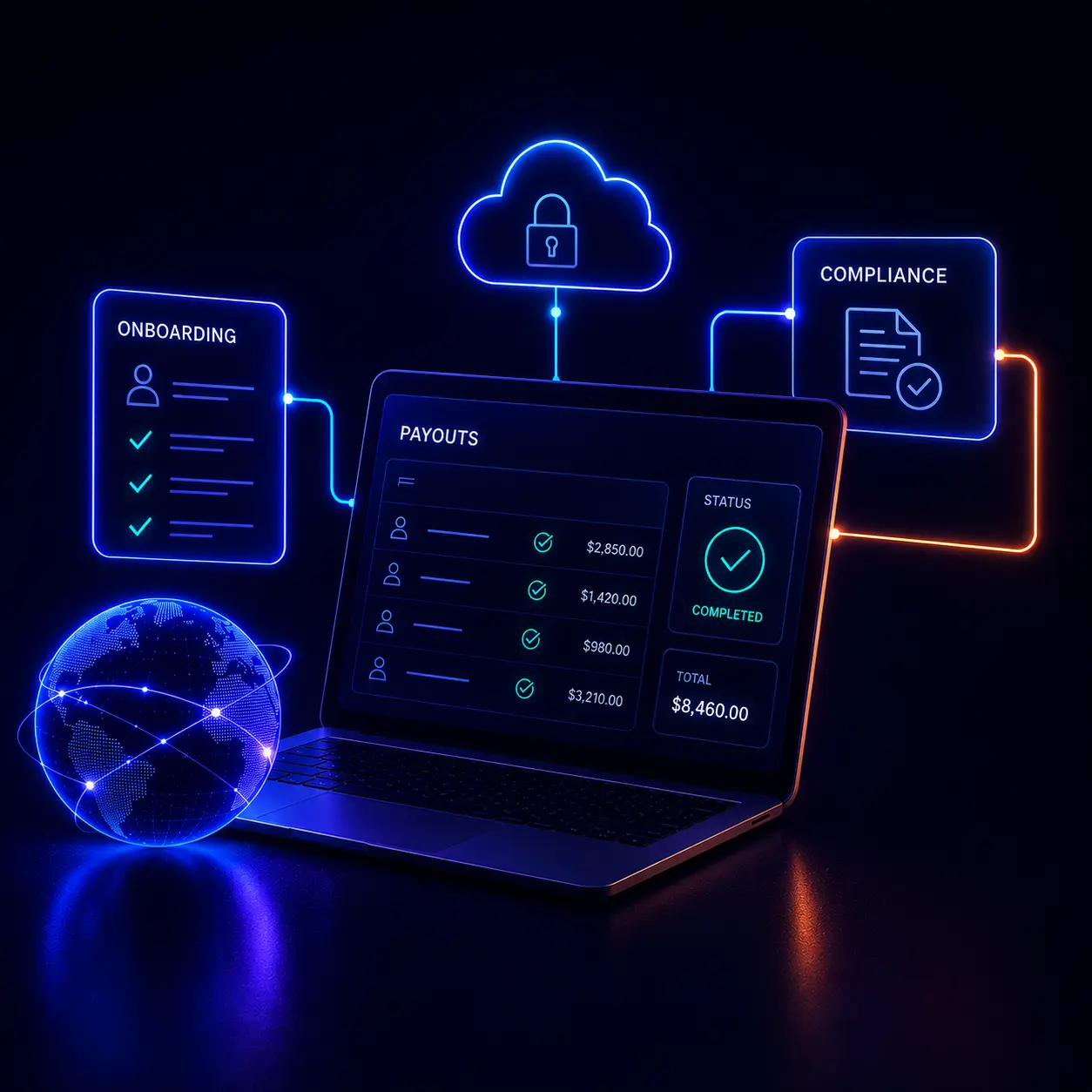








The global workforce is changing. Businesses are increasingly relying on freelancers for everything from software development and graphic design to content creation, translation, AI training, and consulting.
According to the World Bank, online gig workers account for as much as 12% of the global labor force as of 2023, highlighting the growing importance of freelance and independent talent in the global economy. This trend is reflected in the US as well, where Upwork reports that 39% of the workforce performs freelance work in 2026.
While hiring talent across borders has become easier than ever, paying that talent remains a challenge.
We’ll explain how to pay freelancers globally, from onboarding and compliance to payment delivery and reporting, and the best practices organizations use to scale freelancer payout programs efficiently.
What we cover

What are freelancer payments?
Freelancer payments are payments made to independent workers who provide services outside of a traditional employment relationship. These workers may include writers, designers, developers, consultants, translators, moderators, and other specialists who work on a project, contract, or ongoing engagement basis.
Unlike payroll, freelancer payouts often involve workers across multiple countries, currencies, and payment methods. Payment amounts may vary from month to month, onboarding is often ongoing, and recipients have different tax treatments, compliance requirements, and payout preferences depending on where they live.
For organizations paying hundreds or thousands of freelancers, the challenge isn’t simply moving money. It’s managing onboarding, tax documentation, compliance requirements, payment preferences, failed payments, reporting obligations, and recipient support across a globally distributed workforce.
This is why many businesses treat freelancer payments as a specialized payout operation rather than a traditional payroll or accounts payable process.
Freelancers vs. employees
Employees are typically paid through payroll, with employers responsible for withholding taxes, administering benefits, and managing recurring pay schedules.
Freelancers operate differently, but businesses still have significant compliance obligations. Organizations must ensure workers are correctly classified, collect appropriate tax documentation, satisfy reporting and withholding requirements where applicable, and comply with any local regulations governing independent contractors or self-employed workers.
From a payment operations perspective, the biggest difference is that payroll systems are designed around stable employment relationships, while freelancer payout programs must support flexibility, scale, and global reach.
| Category | Employees | Freelancers |
| Payment system | Payroll | Payout operations |
| Payment schedule | Fixed | Variable |
| Workforce size | Relatively stable | Frequently changing |
| Geographic footprint | Often concentrated | Often global |
| Payment methods | Usually limited | Multiple recipient preferences |
| Tax requirements | Payroll tax withholding and employment reporting | Tax form collection, contractor reporting, and cross-border withholding requirements |
| Onboarding | Managed onboarding for a stable workforce | Self-service onboarding for a distributed recipient network |
| Primary challenge | Payroll compliance | Global payout scale and recipient experience |
How to pay freelancers globally
Successfully paying freelancers across borders requires more than selecting a payment method. Organizations need a process that balances payment efficiency, compliance, and recipient experience.
Step 1: Classify workers correctly
Before making payments, businesses should ensure workers are classified correctly under applicable regulations. The key question is whether a worker should be treated as an employee or an independent contractor.
If you’re engaging a worker on a project-by-project basis, allowing them to determine how and when they perform their work, and they provide services to multiple clients, they probably qualify as an independent contractor. On the other hand, if you’re directing how work is performed, setting schedules, integrating the worker into your day-to-day operations, or otherwise treating them as part of your workforce, they’re more likely to be considered an employee.
Worker classification can affect tax treatment, reporting obligations, and compliance requirements. If you’re unsure whether a worker should be classified as an employee or an independent contractor, review the applicable local requirements and seek legal or tax guidance where appropriate.
Step 2: Collect and verify freelancer information
Before you can pay a freelancer, you need enough information to verify who they are, determine their tax status, and deliver funds successfully.
Most organizations collect and verify three categories of information during onboarding:
Identity information
Before sending payments, verify that the freelancer is who they claim to be. Collecting identity information helps reduce fraud risk, support compliance obligations, and ensure funds are delivered to the intended recipient.
This may include:
- Full legal name
- Business name (if applicable)
- Country of residence
- Physical address
- Date of birth
- Government-issued identification
Verification processes may include identity verification (KYC), address verification, and sanctions screening.
Tax documentation
It’s best to collect the documentation needed to support tax reporting and withholding obligations during onboarding.
Depending on the freelancer’s location and tax status, this may include:
- Form W-9 for US persons
- Form W-8BEN for non-US individuals
- Form W-8BEN-E for non-US business entities
- Tax identification numbers (TINs)
- Supporting tax residency documentation
Verification processes may include TIN validation and documentation reviews.
Payment information
You’ll also need the information required to deliver payments through the freelancer’s preferred payout method.
This may include:
- Bank account details
- SWIFT/BIC codes
- IBANs
- Digital wallet information
- Preferred payout currency
- Preferred payment method
Verification processes may include bank account validation and sanctions screening.
Collecting and validating this information before the first payout can significantly reduce payment failures, fraud risk, compliance issues, and support requests later on.
Step 3: Offer the right payment methods
When paying freelancers globally, there is rarely a single payment method that works for every recipient.
Freelancers have different preferences based on their location, banking infrastructure, access to financial services, and how quickly they need access to funds. Offering payment choice can improve the recipient experience, reduce payment-related support requests, and help retain freelancers over time.
Common payout methods include:
Local bank transfers
Local bank transfers are often the preferred option for recurring freelancer payments because they are typically less expensive and faster than international wire transfers. They also provide a familiar recipient experience by allowing freelancers to receive funds through their local banking system. Examples include ACH in the United States, SEPA in Europe, Faster Payments in the United Kingdom, and EFT in Canada.
Mobile wallets
In some markets, freelancers prefer receiving funds through mobile wallets because they provide fast access to earnings without requiring a traditional bank account. Common examples include M-Pesa in Kenya, GCash in the Philippines, and Alipay and WeChat Pay in China.
Debit card payouts
Debit card payouts can provide freelancers with faster access to funds than some traditional banking methods and may be preferred by recipients who want immediate access to earnings. Examples include Visa Direct and Mastercard Send, which enable funds to be pushed directly to eligible debit cards.
International wire transfers
International wire transfers are widely available and useful for larger payments, particularly when local payment rails are unavailable. Most cross-border wire transfers are sent through the SWIFT network. While reliable, wire transfers are often more expensive and slower than local payment methods, making them less suitable for high-volume freelancer programs.
When creating a freelancer payout program, the goal is not necessarily to choose one payment method, but to offer a mix of options that meet the needs of your global freelancer population.
Step 4: Deliver payments and communicate status
Once onboarding, verification, and payment method selection are complete, it’s time to deliver payments to freelancers.
While successfully sending funds is important, the recipient experience doesn’t end there. Freelancers want visibility into where their payment is, when it was sent, and when they can expect to receive it. Without clear communication, even successful payments can generate support tickets and frustration.
To improve the payout experience, organizations should provide payment confirmations when a payout is initiated, estimated delivery timelines, and notifications if a payment fails or requires action from the recipient.
Providing visibility into payment status can help reduce support requests, improve trust, and give freelancers greater confidence that they’ll be paid on time.
Many payout platforms automate these communications, allowing recipients to track their payments and update their payout information without contacting support teams.
Step 5: Maintain tax and compliance records
Compliance responsibilities don’t end once a payment is sent. Organizations must maintain accurate records, monitor documentation requirements, and satisfy ongoing reporting obligations throughout the freelancer relationship.
Depending on the jurisdictions involved, this may include:
- Maintaining valid tax documentation
- Monitoring form expiration dates
- Applying withholding where required
- Issuing end-of-year tax reporting forms
- Retaining records for audit and compliance purposes
For example, US withholding certificates such as Forms W-8BEN and W-8BEN-E generally remain valid until the last day of the third calendar year following signature unless a change in recipient information occurs earlier. Businesses must track expiration dates, collect updated documentation when necessary, and ensure that reporting requirements—such as submitting Forms 1099 and 1042 to the IRS—are met where applicable.
Step 6: Monitor the recipient experience
Payment operations don’t end when funds are sent. Organizations should monitor payment delivery, failed transactions, support requests, and recipient satisfaction to ensure freelancers receive a positive payout experience.
For freelancers, the payment experience shapes their perception of the organization they’re working with. Late payments, unexpected fees, failed transactions, or a lack of visibility into payment status can create frustration, reduce trust, and ultimately make or break a working relationship.
Organizations that regularly measure payout performance and address recurring issues can improve freelancer satisfaction, reduce support requests, and strengthen long-term engagement.
What changes when freelancer programs scale?
The six-step process above can work well manually when managing a small group of freelancers. But as organizations expand internationally, each step becomes more difficult to manage.
As freelancer programs grow, organizations must manage increasing volumes of recipient data, support multiple currencies and payment methods, track tax and compliance requirements across jurisdictions, handle failed payments, and respond to a growing number of recipient inquiries. At the same time, freelancers expect the same level of transparency, flexibility, and reliability regardless of how large the program becomes.
For marketplaces, creator platforms, affiliate programs, media companies, and other businesses that rely on distributed talent, payouts are often part of the overall user experience. A poor payout experience can lead to lower participation, increased support costs, payment disputes, and reduced contributor retention.
What begins as a simple payment process can quickly evolve into a dedicated payout operation. As payment volumes grow and recipient populations become more diverse, many organizations turn to automation and specialized payout infrastructure to manage complexity, maintain compliance, and deliver a consistent recipient experience at scale.
How payout platforms simplify global freelancer payments
Payout platforms help centralize and automate the processes that tend to break as freelancer payments scale, reducing operational overhead and improving the experience for both finance teams and freelancers. Instead of relying on multiple systems and manual processes, organizations can manage the freelancer payout lifecycle through a single platform.
Trolley helps marketplaces, creator platforms, affiliate networks, media companies, and global businesses automate freelancer onboarding, tax collection, compliance workflows, payment delivery, and reporting. With support for payouts in 210 countries and territories and a wide range of payment methods, Trolley enables you to scale your global freelancer program while delivering a better recipient experience.
Whether you’re paying 100 freelancers or 100,000, Trolley provides the infrastructure needed to streamline payout operations, reduce compliance risk, and help freelancers get paid reliably and efficiently.
Learn how Trolley helps businesses pay freelancers globally.