Skilled freelancers choose where to work based on more than hourly rates, and how they get paid sits high on that list. One survey showed that 22% of freelancers report increases in late payments, with nearly half waiting more than 15 days for payment. About 13% didn’t get paid at all.
When you treat freelance payment methods as a purely operational choice against this backdrop, you risk losing top talent to poor experiences. Imagine your globally distributed professionals waiting for payments across different locations and time zones. You select the lowest-cost rail, process the batch, reconcile the payment, and move on. But while some of your freelancers get their payments fast, others face delays or processing issues. You end up with professionals waiting for support and feeling frustrated.
In this context, your payout strategy signals whether your platform is reliable, transparent, and worth continuing to work with. Choose the right mix of freelance payment methods, and you give your freelancers faster access and clearer expectations that result in fewer support headaches. Rely on the wrong one, and you risk making your well-run platform feel unreliable.
There’s no single best way to pay freelancers, and understanding this and pivoting to a mix of methods is the first step toward attracting and retaining top talent. The right approach depends on where your freelancers live and how much operational complexity your team can handle. This guide will walk you through the main freelancer payout options and how to weigh them depending on your needs.
What we cover
- Bank transfers: balancing cost and reliability
- The rise of instant payouts and real-time payment rails
- The role of mobile wallets in global freelancer payments
- The growing use of stablecoins in global freelancer payments
- Why recipient experience matters in freelance payout operations
- Managing tax compliance and verification across payout methods
- Building scalable payout infrastructure for long-term growth

Bank transfers: balancing cost and reliability
Bank transfers are electronic movements of money from one bank account to another. They’ve been the backbone of freelance payout operations because they’re predictable and cost-effective.
With bank transfers, you typically instruct the financial institution to send (push) money to another account or take it from your account (pull).
Domestic bank transfers in the US primarily use two networks: ACH (Automated Clearing House) and the wire transfer network.
In the US, ACH, governed by NACHA (National Automated Clearing House Association), typically batches transfers together and processes them at specific times during the business day. Other regions run on their own equivalents: SEPA (Single Euro Payments Area) across Europe, Faster Payments in the UK, and local bank transfer networks elsewhere, each with its own speed and cost profile.
Wire transfers, on the other hand, move money individually and in near real time. They usually move through the Fedwire Funds Service, operated by the Federal Reserve, for domestic transactions. For international wires, banks rely on SWIFT (the Society for Worldwide Interbank Financial Telecommunication), a global messaging network that sends secure payment instructions between banks across borders. SWIFT itself doesn’t move money. It passes along the instructions, and the funds often hop through one or more intermediary banks before reaching the recipient, adding time and fees to cross-border wire transfers.
The decision between ACH vs wire payments for contractors depends on value and urgency. ACH may be perfectly acceptable for recurring domestic payouts when its low cost can justify the one-to-three business-day settlement. Wires are better reserved for high-value or urgent exceptions, as they speed up delivery at the expense of a higher transaction price.
In practice, many platforms need both: ACH for everyday payments and wires for urgent or high-value exceptions.
The rise of instant payouts and real-time payment rails
A freelancer who sees their earnings hit their account in minutes after finishing a job is far less likely to drift to a competing platform. That’s what makes payment speed integral to gig worker retention and instant payouts so attractive for paying freelancers.
In the US, RTP (the Real-Time Payments network), FedNow, and push-to-card payouts move funds in near real time, including outside banking hours. They allow you to position yourself as a reliable partner in a market where the top talent is already frustrated with late or missing payments.
The tradeoff is the price of this speed. RTP and FedNow settle in seconds but charge a higher per-payment fee. Push-to-card deposits money onto a recipient’s debit card almost instantly, but carries its own per-transaction cost and only works with eligible cards.
Coverage is the other catch. RTP and FedNow only move money when the recipient’s bank is connected to the network, and not every US bank is, so a payout you meant to send instantly can fail to go through. They’re domestic by design, too, so they don’t reach freelancers outside the US.
Push-to-card is the exception. Because it runs over the Visa and Mastercard networks (through services like Visa Direct and Mastercard Send) rather than US banking rails, this payment method can deliver funds to eligible debit cards in many countries, often in the recipient’s local currency and within minutes. For a global freelancer base, that means near-instant payouts without asking workers to open new accounts or wait for local bank transfers. The downside is that card eligibility and supported countries vary, and currency conversion and per-transaction fees can stack up. Where it falls short, local bank transfers and digital wallets do the heavy lifting.
Real-time rails are most valuable when fast access to earnings is part of your platform’s promise to freelancers. They work best as part of a broader payout mix, though, because cost, bank, and geographic limits can prevent them from serving every recipient.
RTP and FedNow are strong options when the recipient’s bank supports them, while push-to-debit can serve freelancers who want instant access or do not keep a linked bank account on file. For international recipients, instant domestic rails generally will not apply, so global payment methods and mobile wallets become more important.
The role of mobile wallets in global freelancer payments
Mobile wallets fill the gaps left by bank rails, especially for international freelancers. How people prefer to get paid varies widely by region, and in many markets, mobile wallets are the default. Wallet payouts allow recipients to receive funds through services they already trust and use every day, without needing to open a bank account or manage another platform. They also expand your reach by supporting markets where mobile wallets are more widely used than traditional banking rails. Services like PayPal and Venmo are popular in some markets, while region-specific wallets play a much larger role elsewhere.
As with any payout method, there are considerations. Wallet payouts may carry higher transaction fees than local bank transfers, and the payment experience can vary depending on the wallet provider. Some wallets offer less visibility into payment status, which can make it more difficult for recipients to track delayed payments and for support teams to answer questions quickly.
Because no single wallet serves every region or recipient, wallets typically work best as one option within a broader payout strategy, giving freelancers the flexibility to choose the payment method that best fits their location and preferences.
The growing use of stablecoins in global freelancer payments
Stablecoins are emerging as a viable option for paying freelancers, particularly for international payouts. A stablecoin is a digital currency pegged to a real-world currency, such as the US dollar, so it tends to hold its value more steadily than cryptocurrencies like Bitcoin. Because stablecoin transactions settle on-chain, directly between digital wallets, they can often be completed within minutes at any time of day, including weekends. This makes it possible to pay freelancers in regions where local banking infrastructure is limited or traditional cross-border transfers are slow or expensive. That reach makes stablecoins especially useful for international contractors and crypto-native creators.
Stablecoins are not the right fit for every recipient, however. Stablecoins are not the right fit for every recipient, however. Freelancers need a compatible crypto wallet, and most will continue to prefer established payment methods such as bank transfers or digital wallets. In cases where recipients convert stablecoins into local currency, additional fees and steps may apply. Tax treatment and regulatory requirements also vary by jurisdiction, so businesses should consider their compliance obligations before offering stablecoin payouts.
Stablecoins work best as one option within a broader payout strategy, giving freelancers who prefer digital assets an additional way to get paid without replacing traditional payment methods.
Why recipient experience matters in freelance payout operations
Freelancers don’t see your payment rails. They only see whether the money arrived on time and whether the fees made sense. That gap between your infrastructure decisions and their experience is where retention is won or lost.
Unexplained freelancer payment delays are among the fastest ways to lose a recipient’s trust. A freelancer who can’t tell why a payment is late will open a ticket, and if your team can’t provide answers, they will move away. That makes transparent, predictable payments integral to retention.
Cost and settlement time matter, but so do visibility and the freelancer’s ability to understand what is happening when a payment is delayed. A payout method that is inexpensive for the platform can still create a poor recipient experience if timing is unclear, fees are surprising, or support teams cannot easily explain where the payment stands.
Evaluating payout methods by speed, cost, and scalability
When comparing freelancer payout options, these four factors can help clarify which tradeoffs are most likely to affect operational overhead or recipient churn:
- Transaction cost: ACH and local bank transfers are the cheapest option, while wires and instant rails cost more per payment. Stablecoin transfers can be inexpensive to send on-chain, but converting to and from local currency adds fees. Many payout platforms also allow businesses to absorb fees, split them with recipients, or pass them through entirely, giving organizations flexibility to balance cost, competitiveness, and recipient experience.
- Settlement time: RTP and push-to-debit are near-instant, while ACH takes days, and wires vary by corridor. Stablecoins settle in minutes, any day of the week.
- International reach: Local bank transfers, mobile wallets, and stablecoins each help extend global coverage, but they serve different recipient preferences and regional payment ecosystems. Supporting multiple payout methods allows businesses to reach more freelancers with their preferred way to get paid.
- Operational complexity: Every added payout rail brings additional integration, reconciliation, and compliance requirements. A payout platform helps centralize these workflows, but methods like stablecoins still come with their own operational considerations.
No single method wins on all four. Strong payout operations combine several methods and route each payment to the rail that fits the recipient. They account for how each choice will show up to the freelancer: how long the payment takes, whether fees are expected, whether the method works in their region, and whether your team can support the payment if something goes wrong.
Managing tax compliance and verification across payout methods
Compliance determines whether a payment can go out at all, so it directly impacts the freelancer’s experience. If tax documentation, identity verification, or year-end reporting are handled separately from payouts, freelancers may not find out that something is missing until a payment is delayed.
Before money moves, you need to collect the right tax documentation (Forms W-9 and W-8). You need to verify the recipient’s identity through KYC (Know Your Customer) and AML (anti-money laundering) checks and prepare for year-end reporting on forms like the 1099-NEC, 1099-MISC, and 1042-S.
As requirements shift by jurisdiction and country, tax-compliant freelancer payouts can become complex fast. When verification and tax workflows are separate from payouts, every new rail or region multiplies manual work and the risk of a costly mistake. Connecting them into one system helps simplify compliance amid a growing worker network.
Building scalable payout infrastructure for long-term growth
As a growing platform, choosing a single payment method to fit all freelancers and gig workers is unrealistic. The more recipients you add, the more their locations and payout preferences pull in different directions, and no single rail can serve all of them at once.
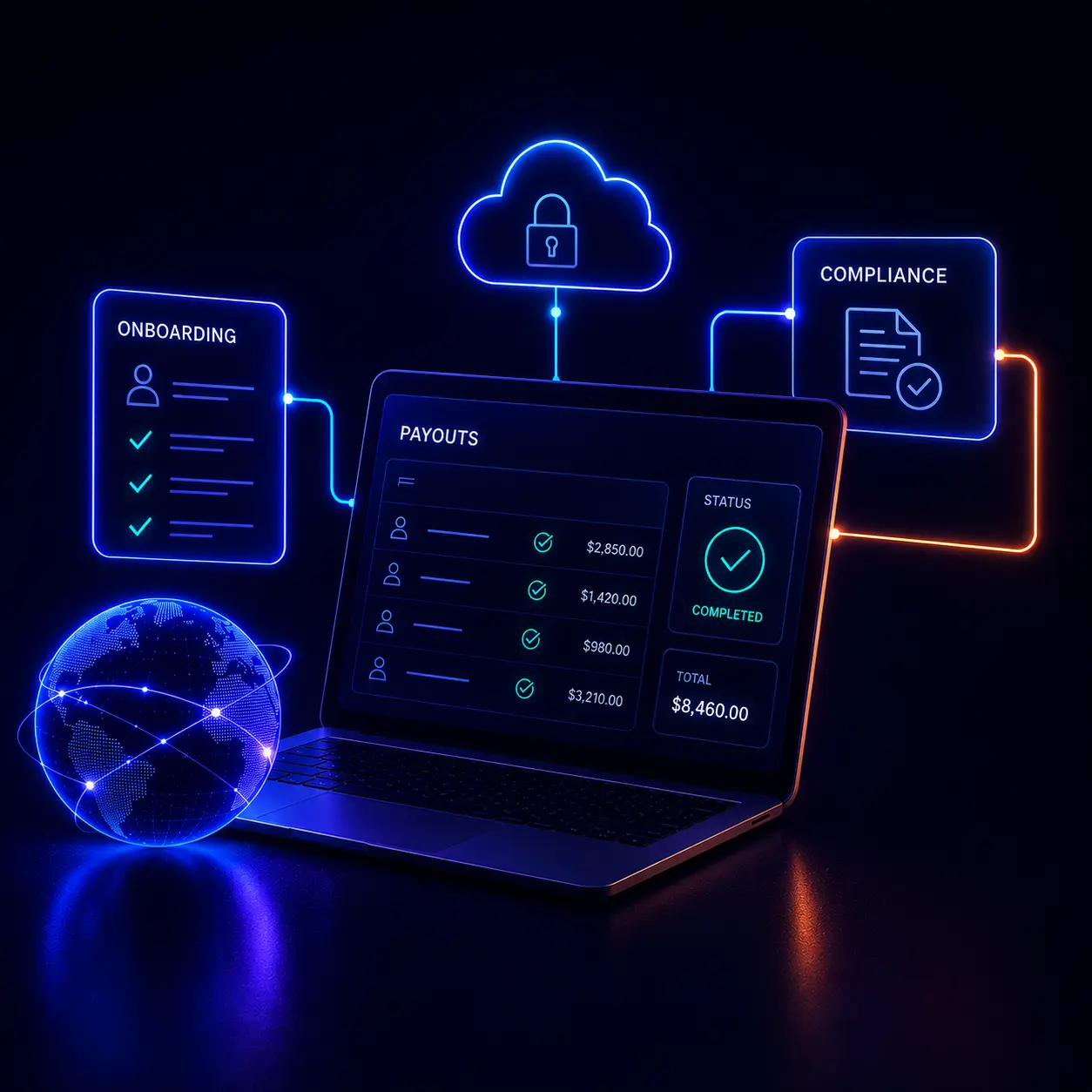
A unified payout infrastructure solves this issue by allowing you to meet your freelancers’ different needs and preferences. It keeps your payouts and worker management in a single connected, automated system, simplifying tax compliance.
Platforms that scale payout operations successfully don’t treat each rail, compliance requirement, or recipient preference as a separate problem. Instead, they bring them together into a single infrastructure built around the recipient. Get that right, and paying freelancers stops being an operational burden and becomes a reason they stay.
See how Trolley keeps the recipient experience at the center of tax-compliant and instant freelancer payouts.