








Paying music royalties sounds straightforward… until it isn’t.
One incorrect payout, one missing tax form, or one delayed transfer can break trust with artists fast. And as your network grows, those risks don’t scale linearly, they multiply.
That’s why choosing the right payout platform isn’t just an operational decision. It’s a product, compliance, and trust decision all at once.
Royalty payments involve recurring distributions, multiple stakeholders, and more complex compliance requirements tied to global rights holders and tax obligations than traditional payouts. Just as importantly, they require confidence that payments are going to the correct rights holders.
Music companies—labels, distributors, DSPs, publishers, and royalty marketplaces alike—must manage complex payment flows to artists, rights holders, and collaborators across the globe.
And, as music businesses scale, challenges quickly emerge: fragmented royalty workflows, manual tax compliance, lack of transparency for artists, and increasing exposure to fraud such as impersonation or incorrect payout destinations.
If you’re evaluating payout platforms for music royalties, this guide compares Trolley vs Tipalti vs Hyperwallet, specifically in how they support music companies. We evaluate how each platform handles royalty payouts, tax compliance, artist experience, fraud prevention, and scalability so you can determine which solution best fits your business.
This guide is for:
- Labels, distributors, and publishers managing recurring royalty payouts
- Platforms paying large global networks of artists or rights holders
- Teams evaluating whether to consolidate payouts, tax, and compliance into one system
What we cover

Comparison table
| Feature | Trolley | Tipalti | Hyperwallet |
| Global payout coverage | 210 countries and territories; 135 currencies | 200+ countries and territories; 120 currencies | ~200 countries and territories; ~50 currencies |
| Royalty workflow support | Integrates with external royalty calculation systems (e.g., Music Maestro) via API or file imports (CSV/XLSX); unifies onboarding, payouts, tax, and compliance in one workflow | Executes payouts and tax on pre-calculated royalties; workflows are split across multiple systems | Handles payout delivery only; most royalty workflows are managed outside the platform |
| Fraud/risk management & IDV | ID verification, watchlists, risk scoring, adaptive workflows | Compliance checks + duplicate detection | Basic verification + AML/sanctions screening |
| Tax compliance | Built-in form collection, generation, and e-filing (W-8, W-9, 1099, 1042-S, OECD digital platform reporting) | Tax form collection with additional workflows and third-party software for some reporting | Primarily supports 1099 workflows; broader tax reporting often requires additional tools |
| FX transparency | Transparent, customizable fee handling | FX depends on setup; fees may impact payees | Limited transparency depending on program |
| Artist onboarding | White-label, customizable, 36 languages | Supplier portal, 27 languages | Hosted portal, ~30 languages |
| Platform control | API-first for product native workflows and dashboards for financial controls | Structured, finance-oriented workflows | Provider-managed workflows with limited control over customization |
Trolley overview
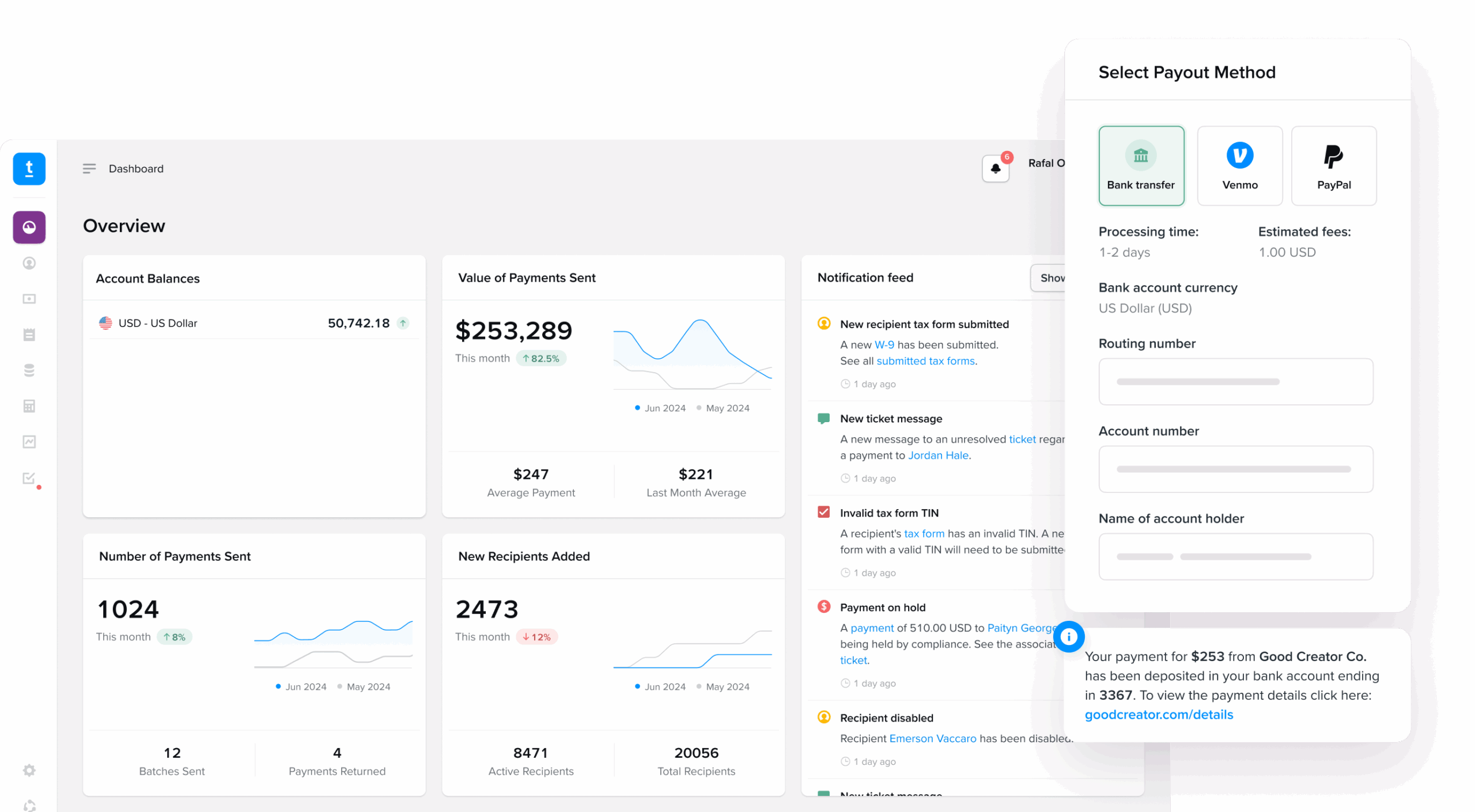
Trolley is a payouts platform designed for companies that need to manage global payments, tax compliance, and fraud and risk management in a single system. It is widely used by music companies such as SoundCloud, United Masters, Downtown Music Holdings, and Bandcamp.
Unlike traditional payout systems, Trolley is built to support product-driven workflows where onboarding, compliance, payouts, and fraud prevention are integrated directly into the platform experience. For companies without a product surface, Trolley also supports finance-led workflows via file imports (CSV/XLSX), ERP integrations, approvals, and batch payout runs managed on an intuitive dashboard.
With Trolley, music companies can onboard artists globally, automate royalty payouts across 210 countries and territories in 135 currencies, manage tax compliance, and verify recipient identities—all within one unified system.
Key feature 1: Flexible royalty payout infrastructure
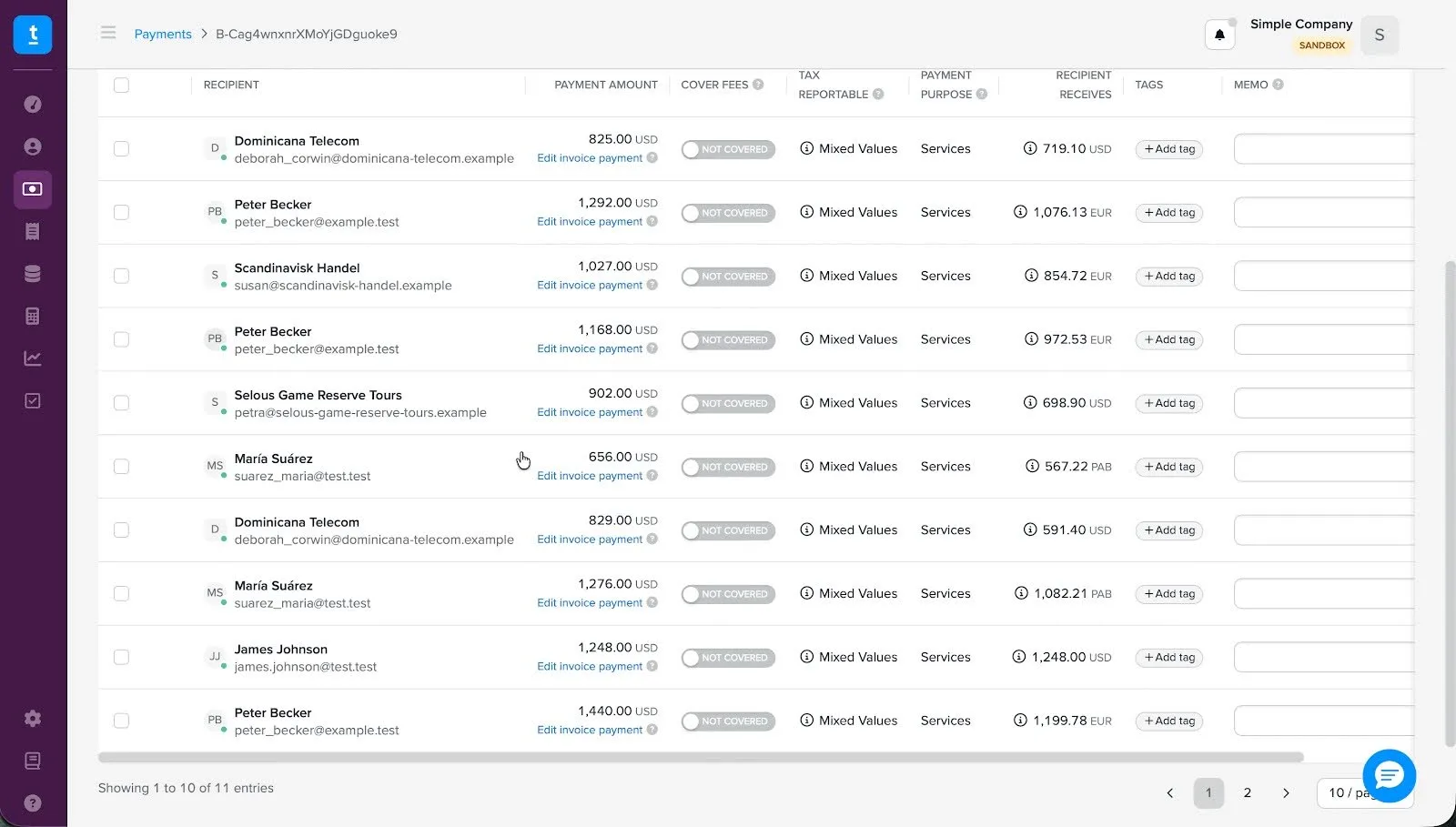
Music companies often process recurring royalty payments across large, global networks of artists and rights holders, typically across multiple systems that introduce delays, manual work, and risk of errors.
Trolley enables platforms to automate these payouts through flexible, API-driven workflows. Payments can be triggered via API or file imports (CSV/XLSX) once royalty data is finalized, allowing payouts to be embedded directly into product or financial workflows.
In addition, Trolley supports sending up to 20,000 payments in a single batch.
This reduces reliance on manual file handling and fragmented processes, while making it easier to scale payout operations as the number of artists and transactions grows.
For example, a distributor paying thousands of artists monthly across multiple territories can automate recurring royalty runs without needing to manually coordinate files, approvals, and payout execution across systems.
Key feature 2: Built-in tax compliance for royalties
Royalty payments require collecting, validating, and reporting tax information across jurisdictions, which often becomes manual, time-consuming, and error-prone when handled across multiple systems.
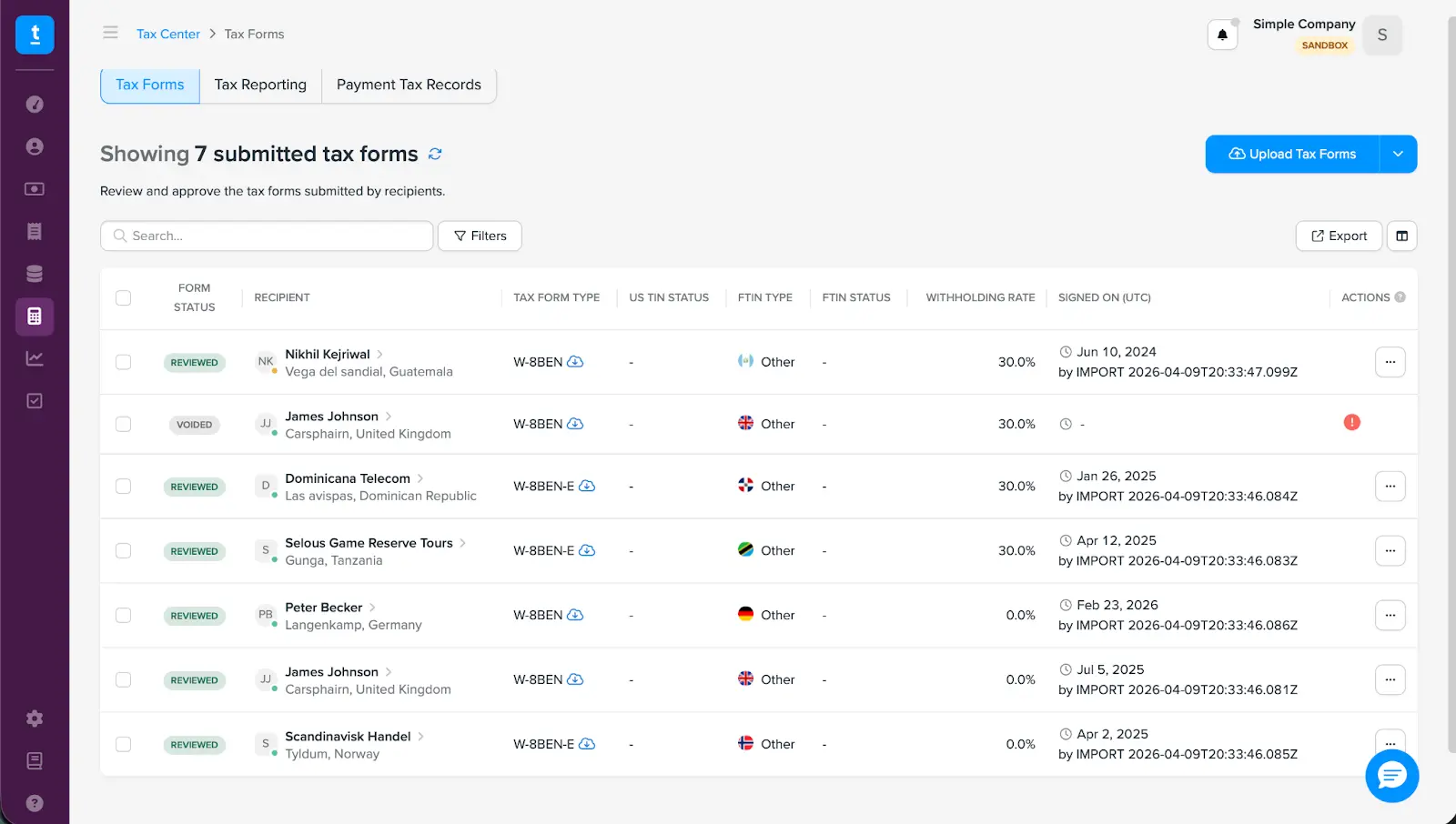
Trolley integrates tax compliance directly into the payout workflow. It supports W-8 and W-9 collection with validation during onboarding, ensuring data accuracy at the source. The platform also enables generation and e-filing of forms such as 1099 and 1042-S, along with support for OECD digital platform reporting requirements in the EU, UK, AUS, and NZ.
By consolidating these workflows, music platforms can reduce administrative overhead and minimize the risk of compliance gaps.
Platforms like Royalty Exchange, which processes over $20 million in annual royalty payouts, reduced processing time from 17 days to 4 days and cut tax-season overtime by 77% after implementing Trolley.
Key feature 3: Artist experience and transparency
When artists lack visibility into when they will be paid, how much they will receive, or why deductions occur, it often leads to confusion, support volume, and reduced trust in the platform.
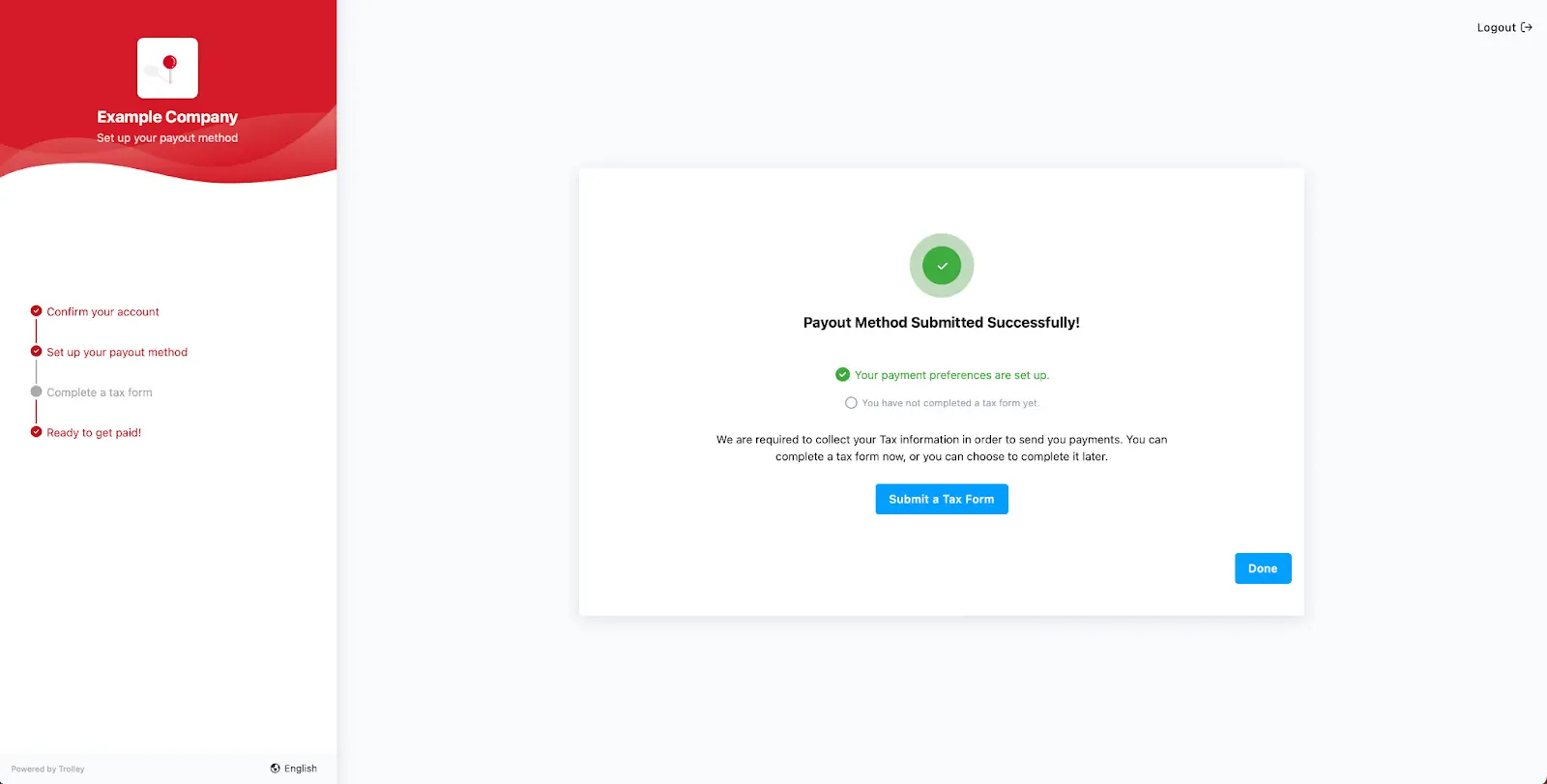
Trolley provides a fully customizable, white-label onboarding and payout experience that allows you to control how artists interact with payments. Artists can manage their payment details, track payout status, and understand exactly what they will receive.
With support for 36 languages and transparent FX handling, platforms can provide a consistent and predictable experience across global artist networks, helping reduce confusion and improve trust over time.
Key feature 4: Know Your Artist (KYA) and fraud prevention
Fraud in music payouts often takes the form of impersonation, duplicate accounts, or incorrect payout details, creating a real risk of paying the wrong artist or rights holder.
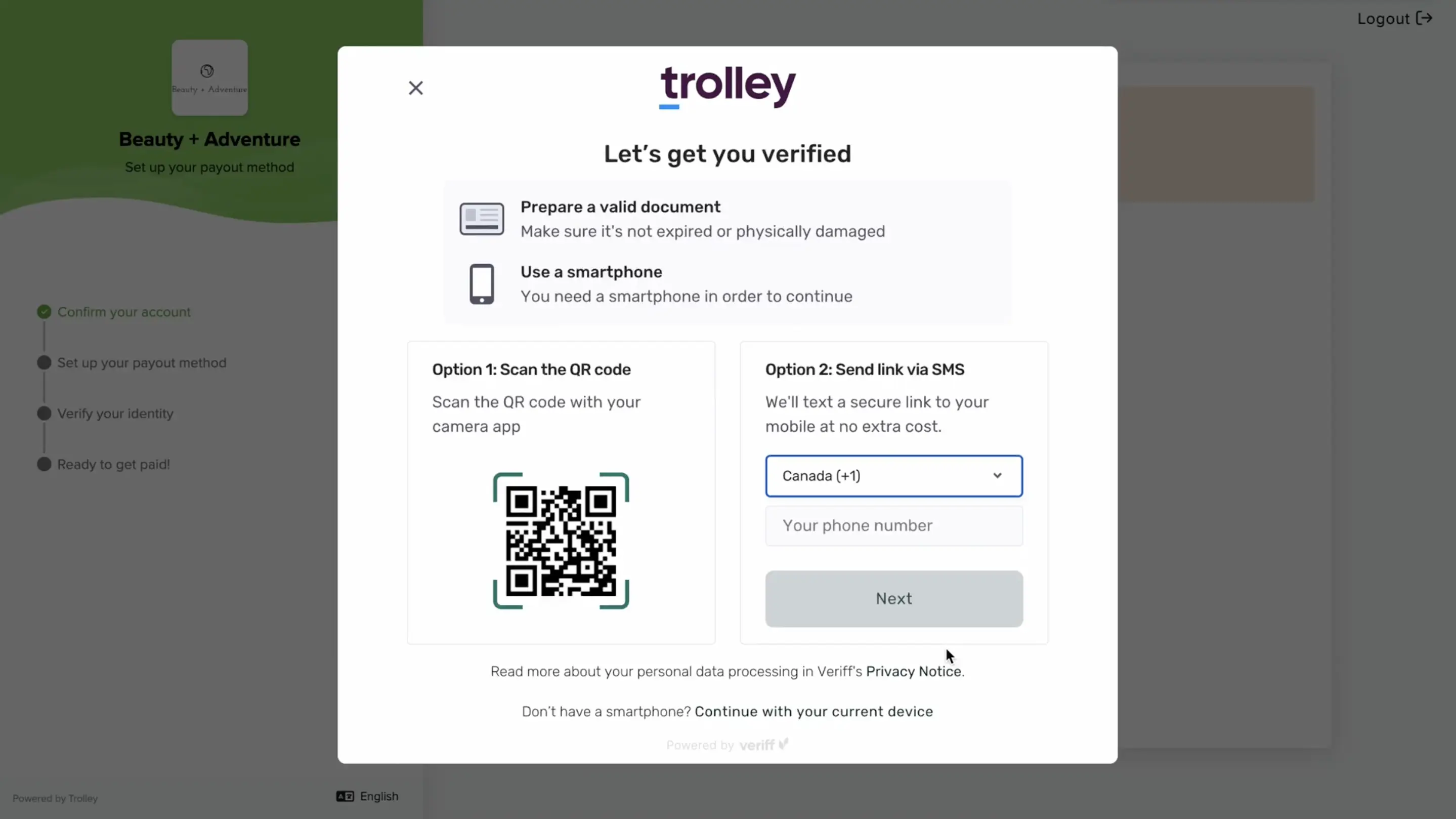
Trolley’s Know Your Artist (KYA) model combines identity verification, watchlist screening, and risk-based workflows to ensure payouts go to legitimate recipients.
This includes government-issued ID verification, behavioral risk signals such as changes in payout details or login activity, and real-time monitoring of account behavior. Suspicious payouts can be flagged or held before funds are released, allowing teams to intervene before errors or fraud occur.
For music platforms, this provides a stronger layer of protection against impersonation, account takeover, and incorrect payouts, while maintaining a streamlined experience for legitimate artists. Platforms like SoundCloud, which manage payouts to large global artist networks, rely on this level of verification and control to ensure royalties are distributed accurately and securely at scale.
Is Tipalti built for royalty payments?
Tipalti is a global payout platform designed primarily for finance and accounting teams managing accounts payable and large-scale payment operations.
In music, Tipalti is typically used to execute royalty payouts and handle tax compliance after royalty calculations are completed upstream. Like Trolley, it supports global payouts and tax workflows.
For music companies, Tipalti provides a structured approach to managing payouts at scale, particularly in finance-led environments, with multi-entity support and tax form collection.
However, its architecture is oriented around scheduled workflows, which can limit flexibility for teams that need to trigger payouts dynamically or customize the artist experience. While Tipalti includes compliance checks like sanctions screening and duplicate detection, these are primarily regulatory controls rather than integrated, lifecycle risk management.
In practice, this means additional tooling or coordination is often required to support product-led workflows and manage risks like impersonation or payout detail changes at scale.
Is Hyperwallet built for royalty payments?
Hyperwallet is a global payout platform focused on payment delivery and recipient cash-out experiences.
It enables businesses to send funds internationally and provides a hosted portal where recipients can receive and withdraw payments using various payout methods. Like other payout platforms, it can be used in music to distribute royalties once amounts are finalized.
However, Hyperwallet is primarily designed as a payout delivery layer rather than a system for managing broader payout workflows. Key elements such as onboarding control, tax compliance, and fraud prevention are either more limited or require external systems.
For music companies, this means Hyperwallet can effectively handle the final step of getting funds to artists, but much of the surrounding workflow—including orchestration, compliance, and experience—must be managed outside the platform.
Feature-by-feature comparison
Royalty workflows and payout operations
Royalty workflows are at the core of music payout operations, often involving recurring distributions, multiple stakeholders, and coordination between systems that calculate, approve, and execute payments.
- Trolley is designed to simplify how these steps connect by combining onboarding, payouts, tax compliance, and recipient management into a single system. It integrates with existing royalty calculation tools and allows teams to move directly from finalized royalty data into payout execution without stitching together multiple workflows.
- Tipalti also supports executing payouts at scale and handling tax workflows once royalty data is ready. Its approach is structured around finance-led processes such as scheduled payment runs, approvals, and reconciliation. This works well for organizations prioritizing control and auditability, but can require additional coordination across systems to manage onboarding, payout logic, and artist experience.
- Hyperwallet focuses primarily on payout delivery, meaning that royalty orchestration, reconciliation, and workflow management must be handled externally. In practice, this often requires additional internal systems or tooling to manage approvals, reporting, and coordination before funds are sent.
For music companies, the key difference is not where royalties are calculated, but how seamlessly payout execution connects to the rest of the workflow—and how much coordination is required between systems as operations scale.
Fraud prevention and identity verification
Fraud prevention is a critical concern in music, where incorrect payouts can directly impact artist trust, revenue, and platform reputation.
- Trolley provides a unified Know Your Artist (KYA) model that connects identity verification, tax data, payout details, and behavioral risk signals into a single recipient profile. This allows platforms to evaluate risk holistically and take action before funds are released.
- Tipalti includes compliance checks such as watchlist screening and duplicate detection, which help identify certain types of risk. However, these capabilities are primarily designed for regulatory compliance rather than a full artist identity and trust model.
- Hyperwallet supports basic verification and AML screening, but offers less depth in areas such as risk scoring, duplicate identity detection, and ongoing monitoring. As a result, platforms may need to rely on additional tools or manual processes to manage fraud risk.
For music companies, proactive identity verification and risk monitoring are essential to prevent fraudulent payouts, protect intellectual property, and maintain trust with artists.
Tax compliance and reporting
Tax compliance is a critical requirement for music companies managing royalty payments across multiple jurisdictions and tax regimes.
- Trolley integrates tax compliance directly into the payout workflow, enabling collection, validation, withholding, and filing in one system.
- Tipalti offers strong tax form support but operates as a separate layer from royalty workflows, requiring integration with upstream systems.
- Hyperwallet provides more limited tax capabilities and often requires additional tools for full compliance.
For music companies, the level of integration between royalty data, payouts, and tax workflows can significantly impact operational efficiency, reporting accuracy, and compliance risk.
Artist experience and onboarding
The quality of the artist experience can directly influence onboarding efficiency, support volume, and long-term trust in the platform.
- Trolley offers a customizable, platform-controlled onboarding experience with multilingual support and transparent payout visibility.
- Tipalti provides a supplier-style onboarding portal, which can be effective but may introduce friction when profile changes invalidate payment or tax setups.
- Hyperwallet delivers a hosted portal experience with payout options but offers less control over the end-user experience and branding.
For music companies, the ability to control and optimize the artist experience can impact activation speed, support overhead, and overall satisfaction with payouts.
Platform flexibility and control
Flexibility and control determine how easily teams can adapt payout workflows and embed them into their product or finance operations.
- Trolley is designed for product-led teams that want payouts and compliance to be embedded directly into their platform.
- Tipalti supports APIs but remains oriented around finance workflows and approval processes.
- Hyperwallet relies heavily on program configuration and provider-managed workflows, which can limit flexibility.
For music companies, greater control over workflows and user experience enables faster iteration, reduced operational dependency on providers, and a more consistent artist experience.
Pros and cons
Trolley
Pros: Unified platform for payouts, tax, onboarding, and fraud prevention; strong artist experience; flexible API-driven workflows.
Cons: Not designed as a full traditional AP platform; lacks purchase order matching.
Tipalti
Pros: Strong tax compliance and payables infrastructure; well-suited for finance-led operations.
Cons: Less flexible for product-driven workflows; requires coordination between systems to manage onboarding, payout execution, and reporting; limited fraud depth compared to KYA models.
Hyperwallet
Pros: Strong global payout delivery and recipient cash-out options.
Cons: Focused on payout delivery rather than full workflow management; limited fraud prevention depth; less platform control; narrower tax capabilities.
Which platform should you choose?
The right platform depends on how your music business operates and where complexity sits in your workflow.
Trolley is best suited for music companies that want a unified system for artist onboarding, payouts, tax compliance, and fraud prevention, with a strong focus on artist trust and platform control.
Tipalti is a strong fit for organizations with established royalty systems that need a downstream layer for payouts and tax operations.
Hyperwallet is best suited for companies primarily focused on payout delivery and recipient cash-out, rather than full royalty workflow management.
For music platforms, the most important factors are often correctness of payouts, fraud prevention, and artist trust—areas where integrated systems tend to provide the most value.
FAQs
What is the best payout platform for music royalties?
It depends on your workflow complexity and scale. Music companies managing recurring global payouts, tax compliance, and fraud risk often benefit from unified platforms like Trolley, while simpler payout needs can be supported by Tipalti or Hyperwallet with additional tooling.
How does Trolley compare to Tipalti for music?
Trolley is built as a unified system for onboarding, payouts, tax, and fraud prevention. Tipalti is oriented around finance-led, scheduled payout runs and approvals; it handles payout execution and tax well, but teams often manage onboarding, artist experience, and payout rules in separate systems.
Is Hyperwallet suitable for music platforms?
Hyperwallet supports global payout delivery and recipient cash-out, but is not royalty-native. Music companies often need additional systems for tax, fraud prevention, and workflow management as complexity grows.
How do these platforms handle tax compliance for music royalties?
Trolley integrates tax collection, validation, and filing directly into payout workflows. Tipalti offers strong tax form support but operates separately from royalty workflows. Hyperwallet primarily supports 1099 use cases and often requires additional tools for broader compliance.
Which platform is best for global payouts to artists and rights holders?
All three support global payouts, but differ in control and integration. Trolley provides unified workflows and broad coverage (210 countries, 135 currencies), Tipalti fits structured finance processes, and Hyperwallet focuses on payout delivery with less workflow integration.