








Gig platforms—businesses that connect independent workers with short-term, on-demand jobs, such as ride-sharing, delivery, or task-based work (e.g., Uber, DoorDash, TaskRabbit)—often need to pay thousands of workers regularly, sometimes even daily, across multiple countries.
As they scale, payout speed, reliability, and compliance can quickly become operational bottlenecks, prompting teams to adopt dedicated payout software.
Common challenges include delayed or failed cross-border payouts, manual tax workflows such as 1099 generation and W-8/W-9 collection, and onboarding experiences that slow worker activation. Platforms may also run into limitations when trying to configure payout logic flexibly or adapt workflows across different regions.
Over time, these issues create friction not only for internal teams such as operations, finance, and product, but also for the workers who depend on consistent and transparent payouts.
In this guide, we compare Trolley vs Tipalti vs Payoneer, specifically in how they deliver for gig platforms. The goal is to offer up an honest evaluation of how each solution handles global payouts, tax compliance, onboarding, and scalability so that you can determine which platform is best aligned with your company’s needs and operational model.
What we cover

Comparison table
| Feature | Trolley | Tipalti | Payoneer |
| Global payout coverage | 210 countries and territories; 135 currencies | 200 countries and territories; 120 currencies | 190 countries; 70 currencies |
| Batch payment scale | Up to 20,000 payments per batch | Up to 5,000 payment instructions per batch | Up to 1,000 transactions per batch |
| Adding funds | Bank transfers and credit card processors (supports staying out of the flow of funds where required) | Bank transfers, debit card from your bank account, and ACH | Bank transfers and ACH only |
| Tax compliance | Native collection, validation, and e-filing (W-8, W-9, 1099, 1042-S, OECD digital platform reporting) | Tax form collection with additional workflows and third-party software for some reporting | No native tax compliance; requires external solutions |
| FX transparency | Per-payment fee visibility with predictable FX outcomes | Documented FX logic; outcomes depend on currency setup | Fees and FX vary by route, currency, and account setup |
| Payee onboarding | White-label onboarding with full UX customization; 36 languages | Supplier portal with limited customization | Standardized onboarding with limited UX control |
| Risk & KYC coverage | Global identity verification and monitoring across 200 countries and territories | Compliance checks and basic verification (primarily financial reporting and vendor payment-focused) | Account verification with limited ongoing monitoring |
| Developer experience | REST API, SDKs, and event-based architecture for platform integration | API available with structured, invoice-based and scheduled payment workflows | Limited API capabilities and customization |
| Multi-entity support | Multi-entity and sub-merchant models with role-based controls | Multi-entity support for organizations managing supplier and vendor payments | Limited multi-entity capabilities |
While all three platforms support global payouts, they differ in how they handle flexibility, compliance, and platform-level control. These differences become more pronounced in high-volume gig environments.
Trolley overview
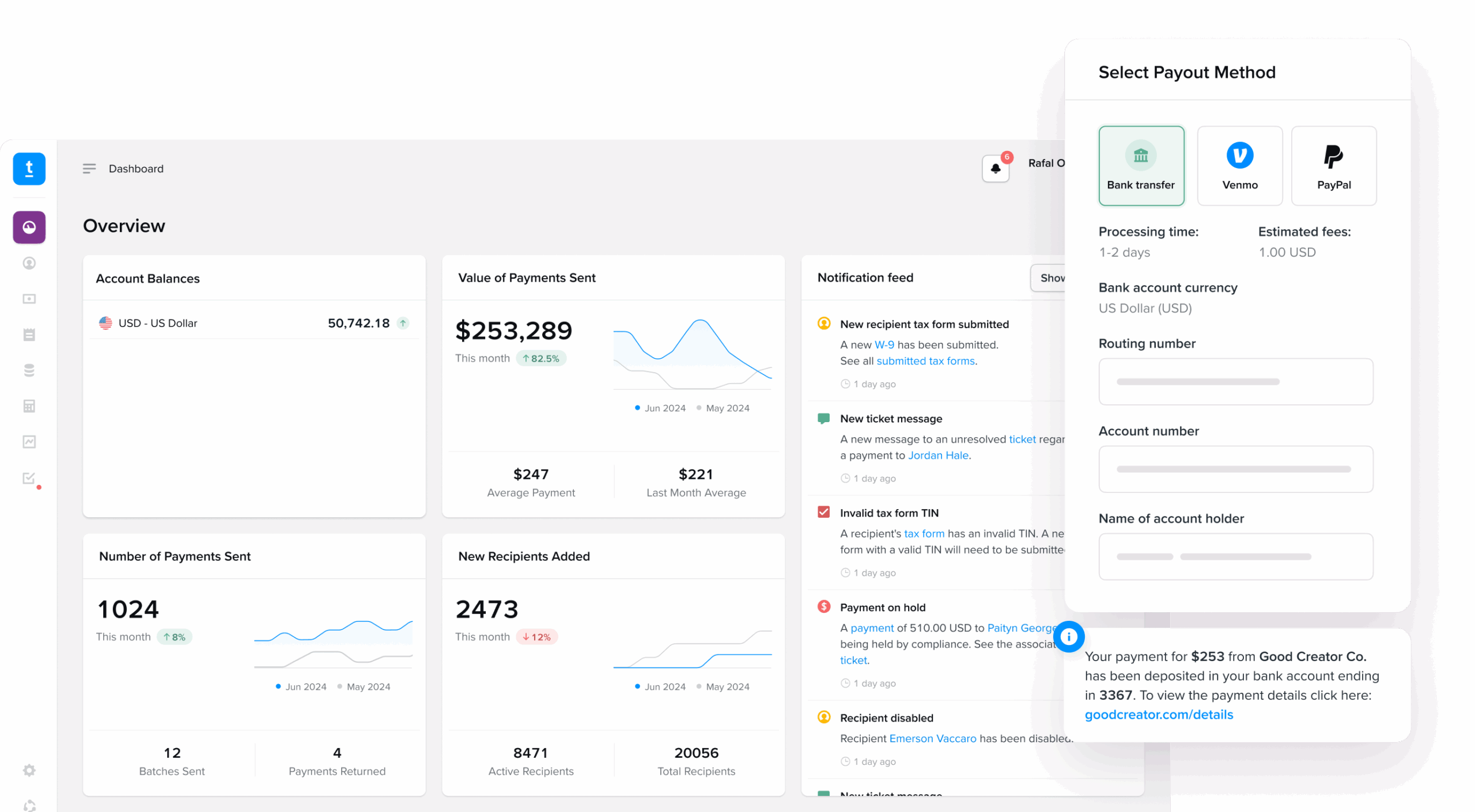
Trolley is a payouts platform designed for companies that need to send high-volume payments to individuals and businesses across multiple countries. It is commonly used by marketplaces, gig platforms, and creator-driven businesses that require a combination of payout automation, compliance handling, and user-facing payment experiences.
Unlike traditional accounts payable systems, which are typically designed around invoice-based workflows, Trolley is built to support platform-driven payout models where onboarding, compliance, and payments are integrated directly into the product experience.
With Trolley, teams can onboard workers globally through a white-label interface, automate payouts across 210 countries and territories and 135 currencies, and manage tax compliance and reporting within the same system. The platform also includes tools for identity verification and risk monitoring, which are relevant for businesses operating at scale across multiple regions.
Trolley key feature 1: Flexible, scalable payout infrastructure
Many payout systems were originally designed for accounts payable use cases, where payments are processed manually or in relatively small batches. This model can introduce limitations for gig platforms that need to process large volumes of payouts on a recurring basis or trigger payments dynamically based on platform activity.
Trolley is designed to support higher throughput and more flexible payout logic. It allows platforms to trigger payouts based on events, such as completed jobs or milestone achievements, rather than relying solely on scheduled payment runs.
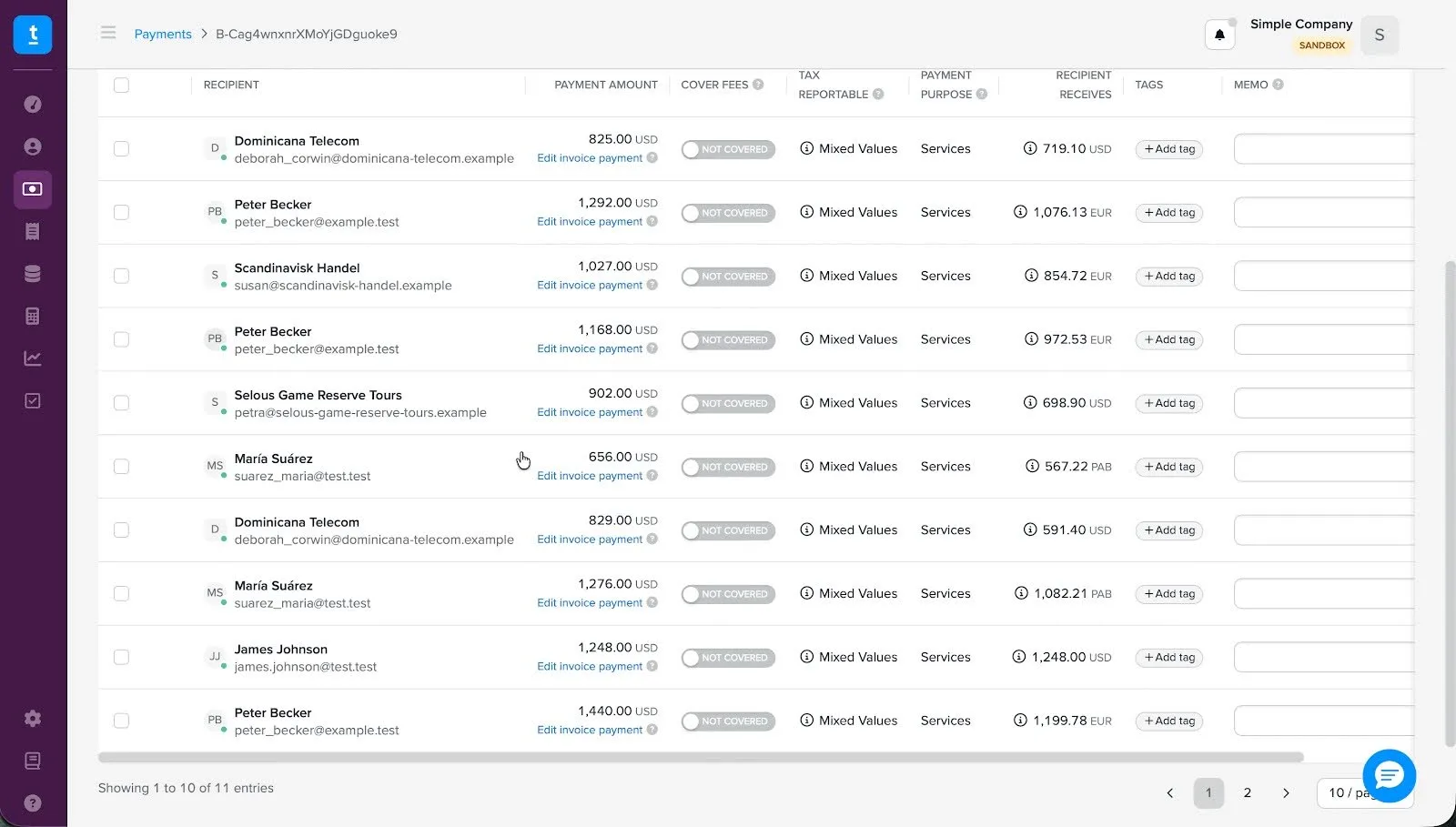
In addition, Trolley supports sending up to 20,000 payments in a single batch, reducing the need for fragmented workflows and manual coordination.
For gig platforms, this type of flexibility in payout infrastructure makes it easier to automate payout cycles, reduce operational complexity, and scale payment operations without needing to redesign internal systems.
Trolley key feature 2: Built-in tax compliance and reporting
Managing contractor tax compliance is a core requirement for gig platforms operating across multiple jurisdictions. This often involves collecting tax forms, validating information, and generating reports for regulatory filings.
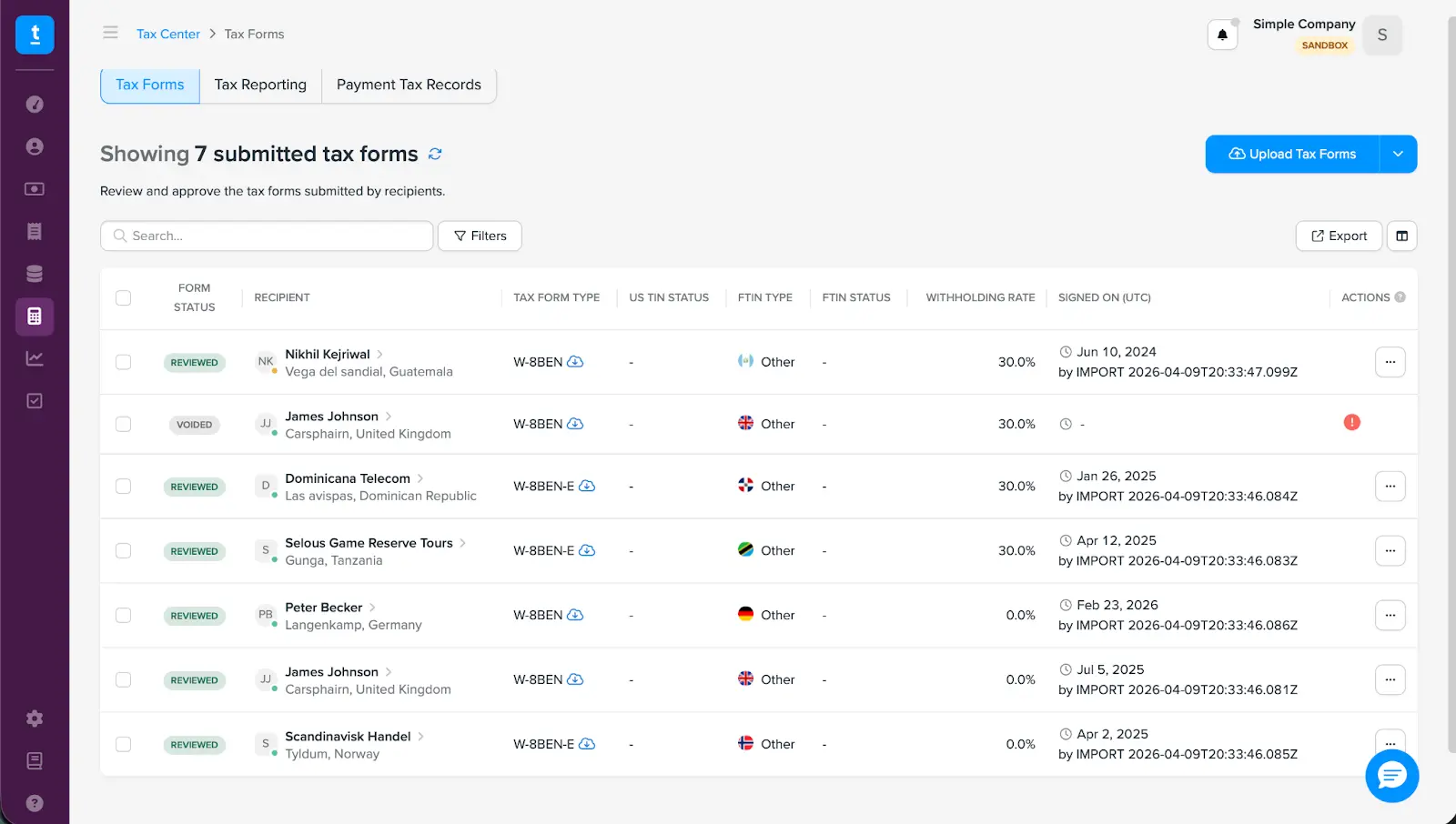
Trolley integrates tax compliance directly into the payout workflow. It supports the collection of W-8 and W-9 forms with built-in validation during recipient onboarding, helping reduce errors at the point of data entry.
The platform also enables the generation and e-filing of forms such as 1099 and 1042-S without requiring additional tools or manual exports.
Beyond U.S. tax requirements, Trolley includes support for international reporting frameworks such as OECD digital platform reporting in the EU, UK, AUS, and NZ, allowing platforms to manage compliance obligations across multiple regions from a single system.
For gig platforms, consolidating these workflows can significantly reduce administrative overhead and lower the risk of compliance gaps as operations expand.
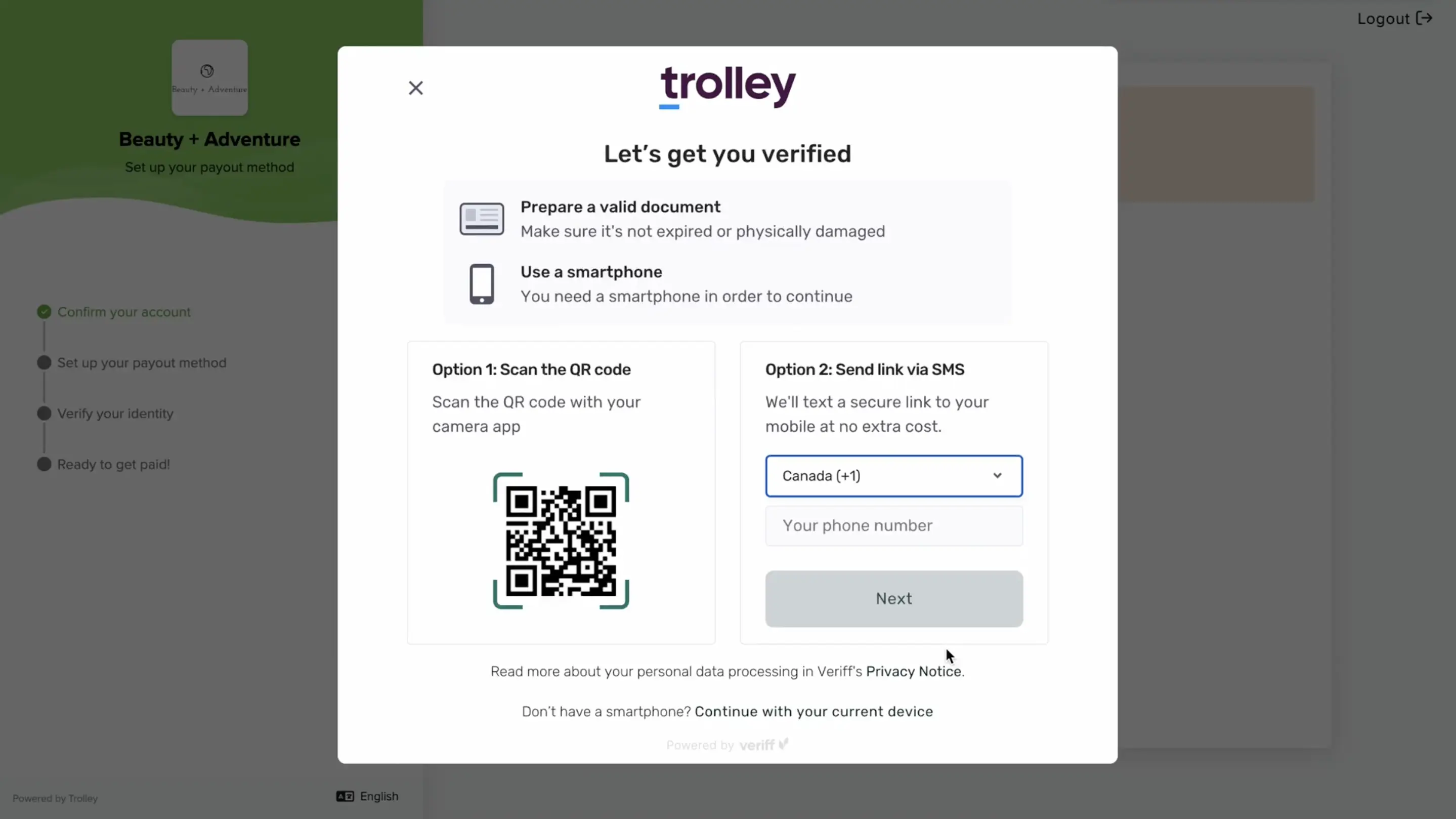
Trolley key feature 3: Worker experience and onboarding
A strong payout experience directly impacts worker activation speed and overall satisfaction with the platform, influencing how quickly workers can begin earning and how they perceive the product.
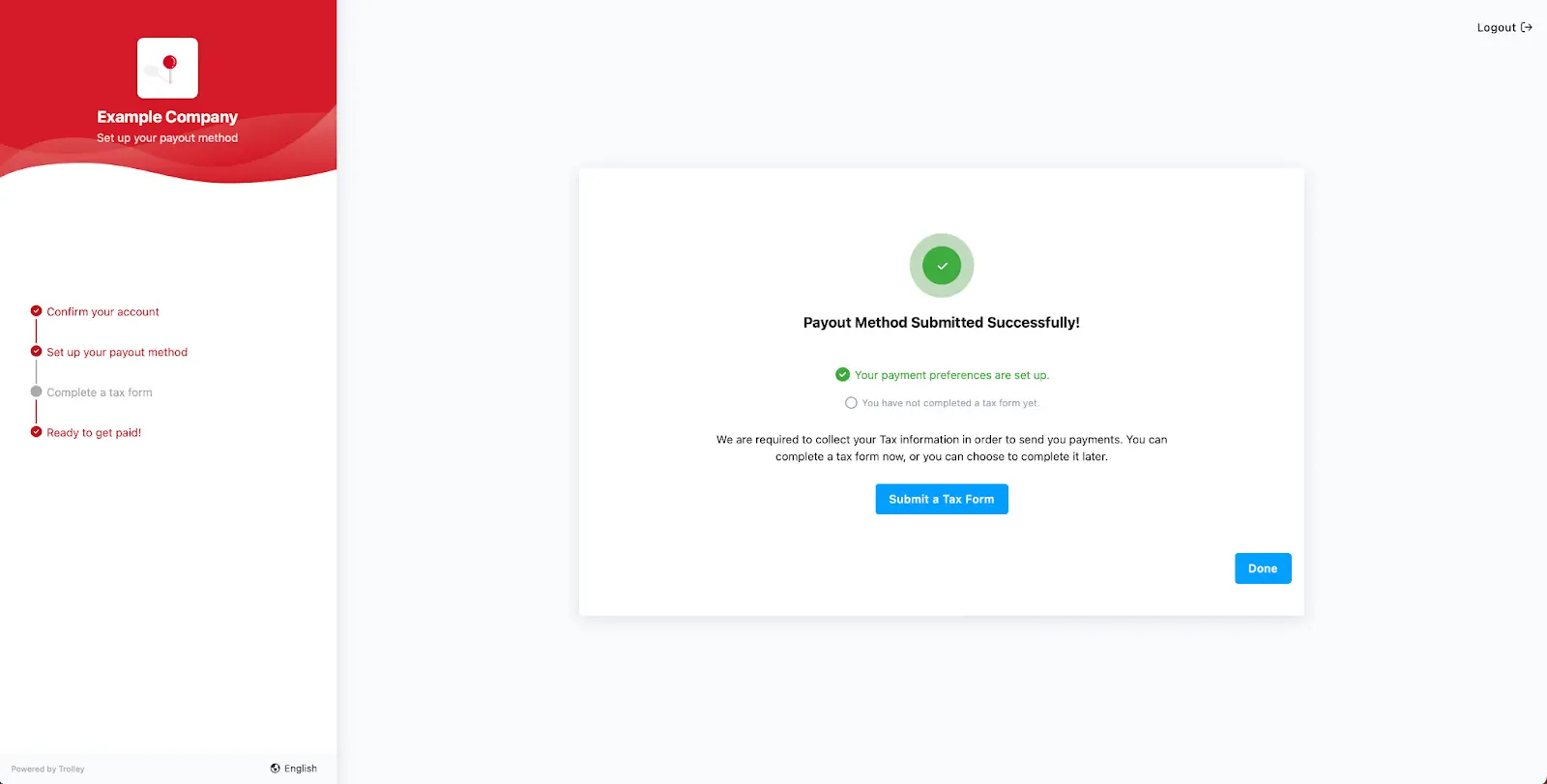
Trolley provides a white-label payee portal that can be fully customized to match your platform’s user experience. It supports onboarding in 36 languages, enabling global platforms to onboard workers more efficiently across regions.
Trolley’s platform also provides clear visibility into payout amounts, fees, and timing, including transparent foreign exchange rates and predictable payout schedules.
For gig platforms, improvements in onboarding and payout visibility can contribute to faster activation, fewer support requests, and higher worker satisfaction.
Trolley key feature 4: Risk management and identity verification
As gig platforms scale, they often need to manage increasing levels of risk related to fraudulent accounts, duplicate users, and compliance requirements across different regions.
Trolley includes identity verification and risk monitoring tools designed to operate across a global user base. It supports verification in more than 200 countries and territories and can validate identities against a large library of government-issued ID templates.
The platform also provides real-time monitoring of account activity, enabling teams to detect unusual behavior or potential risk signals earlier in the payout process.
For gig platforms, these capabilities help reduce fraud, improve compliance, and maintain trust in the payout system without introducing unnecessary friction for legitimate users.
Tipalti overview
Tipalti is a global payables automation platform primarily designed for finance and accounts payable teams. It is commonly used by mid-market and enterprise companies to manage supplier payments, invoice processing, and financial operations.
The platform offers a broad set of capabilities, including global payment support, tax form collection, and compliance workflows. Tipalti is often positioned as an end-to-end solution for managing payables across vendors, suppliers, and partners.
For gig platforms, Tipalti can provide a structured approach to managing payouts at scale, particularly when finance or accounting teams are the primary stakeholders managing payment workflows. It supports multi-entity operations, global payment coverage, and tax form collection.
However, Tipalti’s architecture is more closely aligned with invoice-based and scheduled payment workflows. This can introduce limitations for platforms that need to trigger payouts dynamically based on product events or provide highly customized onboarding and payout experiences for large volumes of individual workers.
In practice, this means that while Tipalti can support gig payout use cases, additional configuration or internal tooling may be required to adapt its workflows to more product-driven environments.
Payoneer overview
Payoneer is a cross-border payments platform that enables businesses to send and receive payments globally. It is widely used for international transfers, freelancer payments, and marketplace payouts, particularly in scenarios where simplicity and global reach are primary requirements.
The platform supports payments to more than 190 countries and offers a range of payout methods, including bank transfers and local receiving accounts. Payoneer is often used by businesses that need a straightforward way to move funds internationally without building complex payout infrastructure.
For gig platforms, Payoneer can be a viable option for enabling cross-border payments to workers, especially in early stages or lower-volume environments. It provides access to a global payout network and can help platforms quickly establish international payment capabilities.
However, Payoneer operates within a more closed ecosystem, and its workflows tend to be less flexible compared to API-driven payout platforms. Limitations such as batch size constraints, variable fees depending on payment routes, and less customizable onboarding experiences can become more noticeable as payout volumes increase or operational complexity grows.
In addition, Payoneer charges fees to recipients when they withdraw funds from their Payoneer accounts, which reduces net earnings. In contrast, Trolley allows platforms to customize and split transaction fees based on their business model, giving greater control over how costs are allocated between the platform and the recipient.
As a result, Payoneer is often best suited for businesses prioritizing ease of use and global coverage, rather than those requiring highly customizable, platform-integrated payout workflows at scale.
Feature-by-feature comparison
Global payout coverage and reliability
All three platforms support global payouts, but they differ in how they handle scale and predictability.
- Trolley supports payouts to 210 countries and territories in 135 currencies and is designed to send payments through a mix of local payment rails and global methods. This allows platforms to optimize for speed, cost, and delivery reliability depending on the region.
- Tipalti also offers broad global coverage, supporting more than 200 countries and territories in 120+ currencies. Its infrastructure is well-suited for organizations managing supplier payments and international vendor relationships.
- Payoneer provides access to a large global network as well, supporting payments in over 190 countries in 70+ currencies. However, payout timing and delivery can vary depending on the payment route, and some users report delays related to settlement processes or reserve policies.
For gig platforms operating at scale, differences in payout predictability and delivery transparency can have a direct impact on worker trust and support volume.
Flexibility and API-driven workflows
Flexibility is one of the most significant differences between these platforms, particularly for product-led teams.
- Trolley is designed as an API-first platform, allowing payouts to be triggered by platform events such as completed jobs, milestones, or earnings thresholds. This makes it easier to embed payouts directly into the product experience and automate workflows without relying on manual intervention. It also supports high-throughput operations, including up to 20,000 payments per batch, which helps platforms scale payout execution without splitting runs.
- Tipalti offers API access but is more structured around invoice-based and scheduled payment workflows, such as invoice processing and scheduled payment runs, and supports up to 5,000 payment instructions per batch. While it can be adapted for platform use cases, doing so may require additional configuration or internal tooling.
- Payoneer provides more limited workflow customization and is generally better suited for standardized payout flows rather than highly dynamic or event-driven systems, with batch sizes typically capped at around 1,000 transactions.
For gig platforms that need to automate payouts at scale or customize payment logic across different regions and use cases, API flexibility—and the ability to handle large batch volumes—becomes a key consideration.
Tax compliance and regulatory coverage
Tax compliance is a critical requirement for gig platforms managing payments to contractors across multiple jurisdictions.
- Trolley includes built-in tax compliance features that allow platforms to collect W-8 and W-9 forms, validate tax information, and generate and e-file forms such as 1099 and 1042-S directly within the platform. It also supports international reporting frameworks such as OECD digital platform reporting requirements.
- Tipalti provides tax form collection and compliance workflows, but in some cases may require exporting data or using additional third-party tools for certain reporting requirements, depending on the implementation and use case.
- Payoneer does not provide native tax compliance infrastructure and typically requires platforms to manage tax reporting separately or through third-party solutions.
For gig platforms, the level of integration between payouts and tax workflows can significantly affect operational efficiency and compliance risk.
Worker experience and onboarding
The quality of the payee experience can influence both user satisfaction and operational efficiency.
- Trolley offers a white-label onboarding and payout experience that can be customized to match the platform’s branding and user flows. It supports onboarding in 36 languages and provides a centralized portal where users can manage their payment details and track payout status.
- Tipalti includes a supplier portal for onboarding and payment management, supports onboarding in 27 languages, but customization options may be more limited depending on how the platform is configured.
- Payoneer provides a standardized user experience that is consistent across its ecosystem, supports onboarding in 22 languages, but offers less flexibility for platforms that want to fully control the onboarding and payout interface.
For gig platforms, the ability to control and optimize the onboarding experience can impact activation rates, support volume, and long-term user retention.
Risk management and identity verification
As payout volume increases, so does exposure to fraud and compliance risks.
- Trolley provides identity verification and risk monitoring across 200 countries and territories, with support for validating a wide range of government-issued IDs. It also includes real-time monitoring of account activity and configurable risk workflows.
- Tipalti includes compliance checks such as sanctions screening and basic verification, but its capabilities are more focused on financial compliance rather than ongoing risk monitoring for large networks of individual users.
- Payoneer includes verification processes for account setup, but risk monitoring and fraud detection capabilities may require additional manual oversight or external systems.
For gig platforms, proactive risk management can help prevent fraudulent payouts, reduce operational overhead, and maintain trust across the marketplace.
Pros and cons
Trolley
Trolley is designed for platforms that need flexibility, global scale, and integrated compliance.
Pros: Trolley offers API-first payout workflows that can be triggered by platform events, supports high batch volumes, and integrates tax compliance directly into the payout flow. It also provides a customizable, white-label payee experience and global identity verification across a wide range of jurisdictions.
Cons: Trolley does not support traditional contract-based self-billing workflow. Businesses that rely heavily on invoice-driven or self-billing processes may find Tipalti better suited for those traditional accounts payable use cases.
Tipalti
Tipalti is well-suited for organizations with invoice-based and scheduled payment workflows and complex payables operations.
Pros: Tipalti provides a comprehensive accounts payable solution with strong support for supplier payments, multi-entity operations, and financial controls. It also includes tax form collection and global payment capabilities.
Cons: Tipalti’s workflows are more aligned with invoice-based processes, which can make it less flexible for platform-driven payout models. Adapting it to gig work use cases may require additional configuration or internal tooling.
Payoneer
Payoneer is designed for cross-border payments and is often used for straightforward international transfers.
Pros: Payoneer offers broad global coverage and is relatively easy to set up, making it a practical option for businesses that need to start sending payments internationally quickly.
Cons: Payoneer provides less flexibility in workflow customization, has lower batch limits, and does not include built-in tax compliance infrastructure. These limitations can become more pronounced as payout volume and operational complexity increase.
Which platform should you choose?
The right payout platform depends on how your business operates, who owns payout workflows internally, and how much flexibility you need as you scale.
Trolley is typically the best choice for gig platforms and marketplaces that need to manage high-volume payouts to individuals across multiple regions. It is particularly well-suited for teams that want to embed payouts directly into their product experience, automate compliance, and maintain control over onboarding and payout workflows.
Tipalti is often a strong fit for organizations where finance or accounting teams manage payouts as part of broader accounts payable operations. It works well in environments where payments are tied to invoices or supplier relationships rather than dynamic platform events.
Payoneer can be a practical option for businesses that need a simple way to send cross-border payments and do not require deep customization or integrated compliance workflows. It is often used in earlier-stage or lower-complexity payout environments.
For gig platforms specifically, the key decision factors tend to be flexibility, scalability, and the ability to integrate payouts, compliance, and user experience into a single system. Platforms that prioritize these capabilities often benefit from solutions that are purpose-built for product-led payout models.
FAQs
What is the best payout platform for gig marketplaces?
The best payout platform for a gig marketplace depends on the level of scale, geographic reach, and operational complexity. Platforms that require high-volume payouts, integrated tax compliance, and customizable onboarding often benefit from solutions like Trolley, while simpler use cases may be supported by tools like Payoneer or Tipalti depending on internal workflows.
How does Trolley compare to Tipalti for gig platforms?
Trolley and Tipalti differ primarily in how they are designed to be used. Trolley is built for platform-driven payout workflows, where payments are triggered by product events and integrated into the user experience. Tipalti is designed for accounts payable processes, which can make it better suited for finance-led environments but less flexible for gig work use cases.
Is Payoneer a good option for large-scale payouts?
Payoneer can support international payments, but it may be less suitable for large-scale, high-volume payout operations that require advanced workflow customization, higher batch limits, or integrated compliance. These factors often become more important as platforms grow.
How do these platforms handle tax compliance?
Trolley provides built-in tax compliance features, including form collection (W-9/W-8 BEN/W-8 BEN-E) and e-filing for forms such as 1099 and 1042-S, along with support for digital platform reporting requirements in the EU, UK, AUS, and NZ. Tipalti includes tax form collection but may require additional workflows depending on the use case. Payoneer does not provide native tax compliance infrastructure and typically requires external solutions.
Which platform is best for global payouts to gig workers?
All three platforms support global payouts, but they differ in how they handle flexibility, transparency, and integration. Trolley is designed for platforms that need control and scalability and supports payouts to 210 countries and territories. Tipalti is aligned with invoice-based and scheduled payment workflows, and Payoneer focuses on enabling cross-border transfers with simpler workflows.