








Paying creators is more complex than simply sending money from point A to point B.
Creator platforms often need to combine multiple revenue streams—subscriptions, ad revenue shares, tips, affiliate commissions, bonuses, and one-off campaign payments—into a single payout workflow. That means the payout stack has to do more than move funds. It needs to handle onboarding, tax collection, payout method selection, compliance checks, and payment visibility at scale.
As platforms grow, these requirements become harder to manage. Teams often run into fragmented payout workflows, inconsistent global coverage, manual tax processes, and increasing fraud or compliance risk tied to large networks of individual payees.
That’s where payout infrastructure choices start to matter.
Some platforms are built primarily for payments and funds flow orchestration. Others focus on payout delivery. And others are designed specifically for payout operations, onboarding, and tax compliance.
In this guide, we compare Trolley vs Stripe Connect vs Hyperwallet, specifically in how they help support creator economy platforms. The goal is to provide a clear, practical evaluation of how each solution handles global payouts, creator experience, compliance, and scalability so you can determine which platform best fits your business.
What we cover
- Comparison table
- Trolley overview
- Trolley key feature 1: Flexible payout orchestration across multiple revenue streams
- Trolley key feature 2: Built-in global tax compliance for creators
- Trolley key feature 3: Creator onboarding and payout experience
- Trolley key feature 4: Risk management and identity verification
- Trolley key feature 5: Multi-entity support and flow of funds flexibility
- Stripe Connect overview
- Hyperwallet overview
- Feature-by-feature comparison
- Pros and cons
- Which platform should you choose?
- FAQs

Comparison table
| Feature | Trolley | Stripe Connect | Hyperwallet |
| Global payout coverage | 210 countries and territories; 135 currencies | ~118 countries for Connect payouts; broader via Stripe ecosystem | ~200 countries and territories; coverage varies by program and method |
| Payout orchestration | Batch-based, event-driven by API, multi-source workflows | Event-driven via charges, balances, and connected accounts | Program-based (Virtual Accounts, straight-through payouts) |
| Tax compliance | W-8/W-9, 1099, 1042-S, withholding, OECD digital platform reporting, e-filing | Strong 1099 support; DAC7 reporting; more limited non-US depth | 1099 workflows, W-8/W-9 collection; broader reporting via add-ons |
| FX transparency | Transparent, configurable FX handling | Transparent pricing, but fees can stack across products | Fees vary by program, method, and region |
| Creator onboarding | White-label onboarding; 36 languages | Hosted/embedded onboarding for connected accounts | Hosted Pay Portal; 30+ languages |
| Risk & KYC | KYC/KYB, identity verification, AML/sanctions screening, monitoring, and payout controls | KYC/KYB, AML/sanctions screening, identity verification | Payee verification, AML/sanctions screening, monitoring |
| API flexibility | Comprehensive API for recipients, payments, batches, and webhooks | Extensive APIs across payments and payouts | APIs available but constrained by program configuration |
| Batch processing | Up to 20,000 payments per batch | No standard batch model; payouts triggered individually or scheduled | Batch file processing supported; typical limits lower and program-dependent |
| Multi-entity support | Supports multi-entity and sub-merchant models within one account | Supports multiple entities via separate Stripe accounts and connected account structures | Supports multiple entities through program-based configurations, typically separated by region or business unit |
| Flow of funds | Supports both in-flow and out-of-flow of funds models, depending on business and regulatory requirements | Supports both models, but with limitations due to connected account structure | Supports flow of funds models but typically requires PayPal involvement and program setup |
Trolley overview
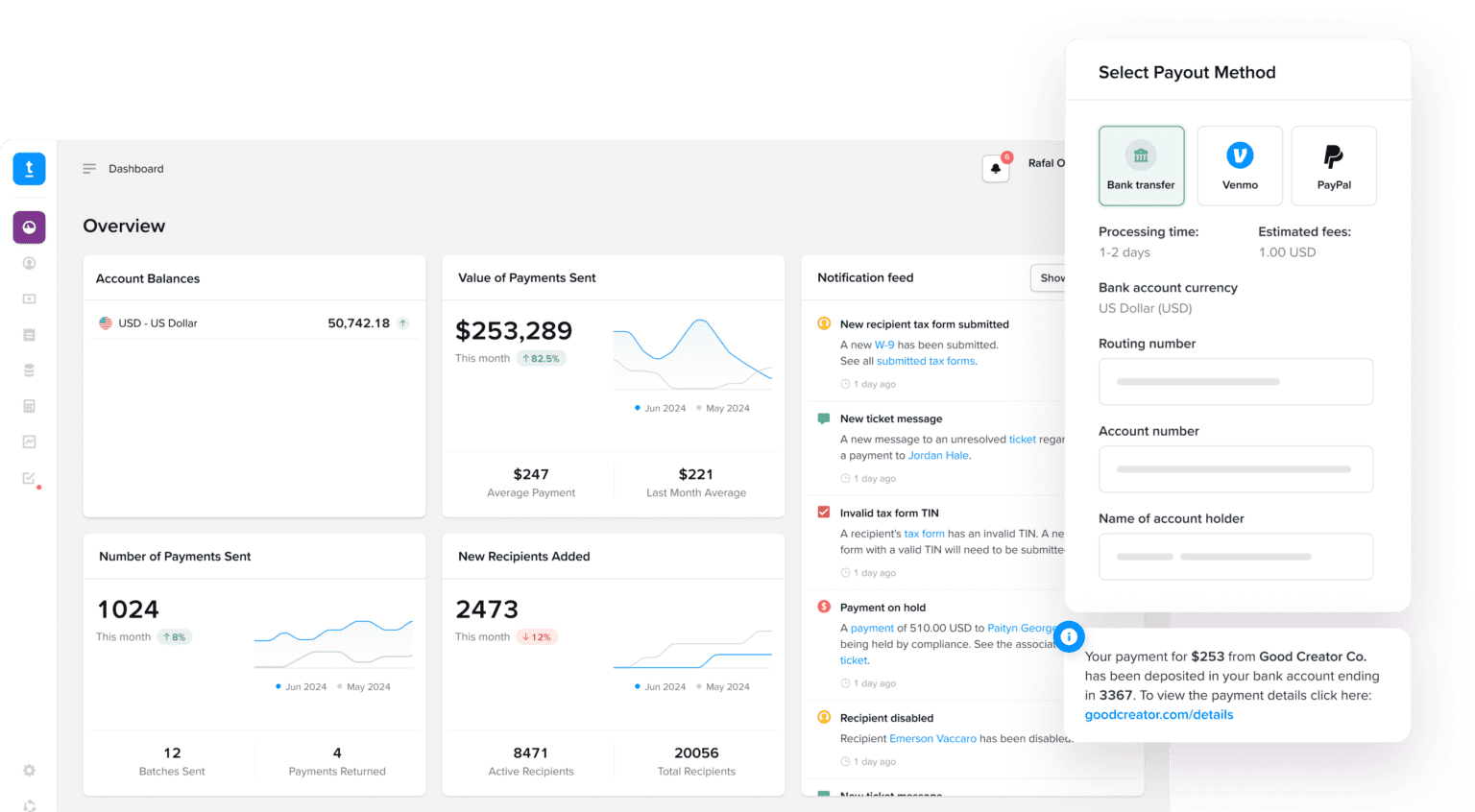
Trolley is a payouts platform designed for companies that need to manage global payments, tax compliance, and recipient verification in a single system.
It is commonly used by creator platforms, marketplaces, and digital businesses that need to pay large networks of individuals across multiple countries. Unlike traditional payment infrastructure, Trolley is built specifically for payout operations—where onboarding, compliance, and payments are tightly integrated into the product experience.
With Trolley, platforms can onboard creators globally, automate payouts across 210 countries and territories, manage tax compliance, and verify recipient identities within the same system. It also provides a flexible API that allows teams to integrate payout workflows directly into their product and automate payment operations at scale.
Trolley key feature 1: Flexible payout orchestration across multiple revenue streams
Creator platforms rarely operate on a single revenue stream. A single creator may earn from subscriptions, ad revenue, tips, affiliate programs, and bonuses, all with different timing and payout logic.
Many systems struggle to unify these inputs into a consistent payout workflow.
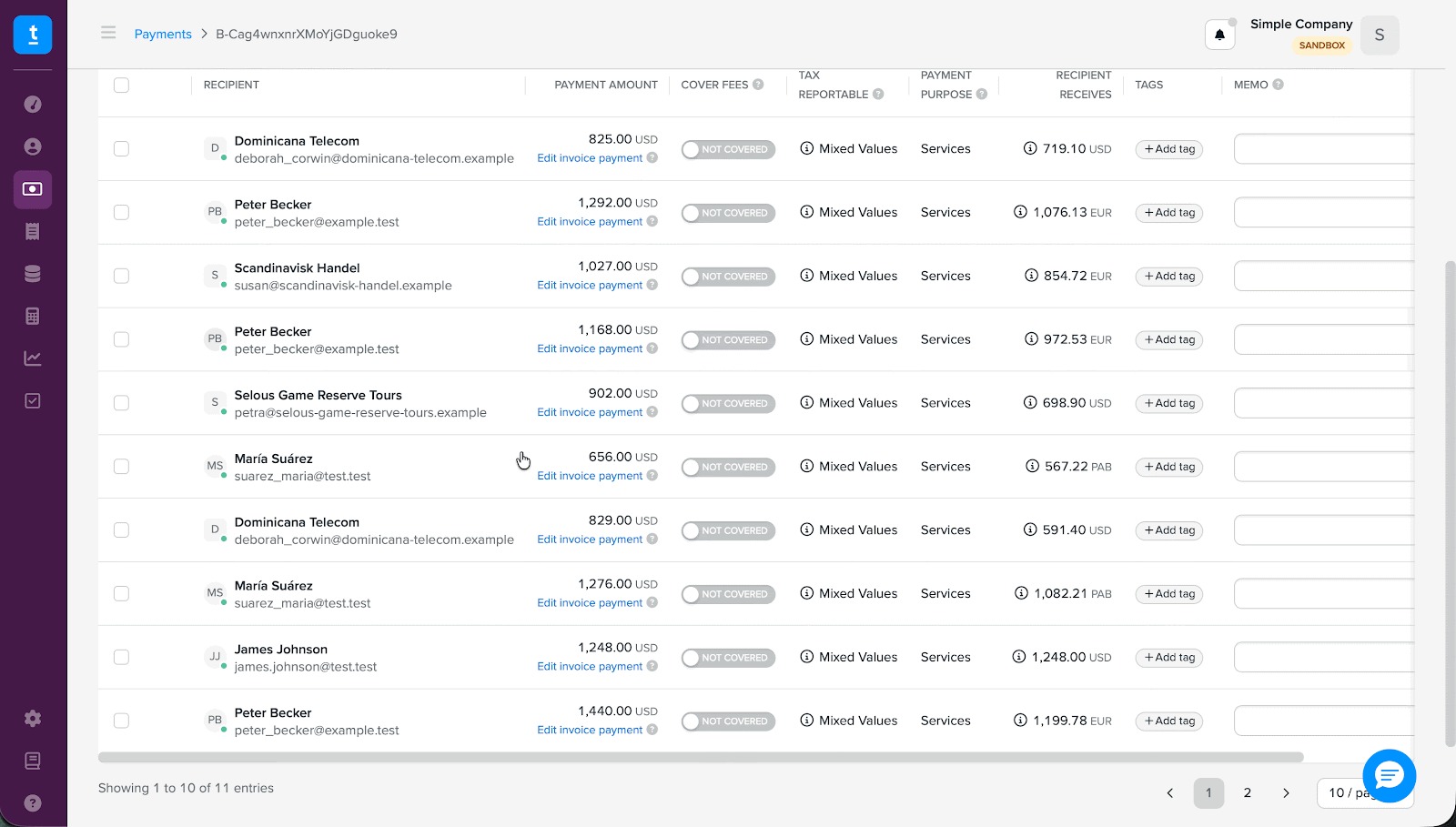
Trolley is designed to handle this operational complexity. It allows teams to ingest payout data from multiple sources—via API, CSV uploads, the platform dashboard, or integrations—and consolidate them into structured payout runs. Its API-first design also enables platforms to programmatically trigger, manage, and automate payout workflows as part of their core product logic.
This includes support for approvals, batching, and scheduled workflows, enabling platforms to manage payouts as an integrated operational process rather than a series of one-off transactions.
For creator platforms, this makes it easier to standardize payout execution, reduce manual coordination, and scale payout operations as earnings models become more complex.
Trolley key feature 2: Built-in global tax compliance for creators
Tax compliance is a core requirement for platforms paying creators across jurisdictions.
This includes collecting tax forms, validating information including TINs, handling withholding, and generating forms and reports for regulatory filings. When managed across separate systems, these workflows often become fragmented and error-prone.
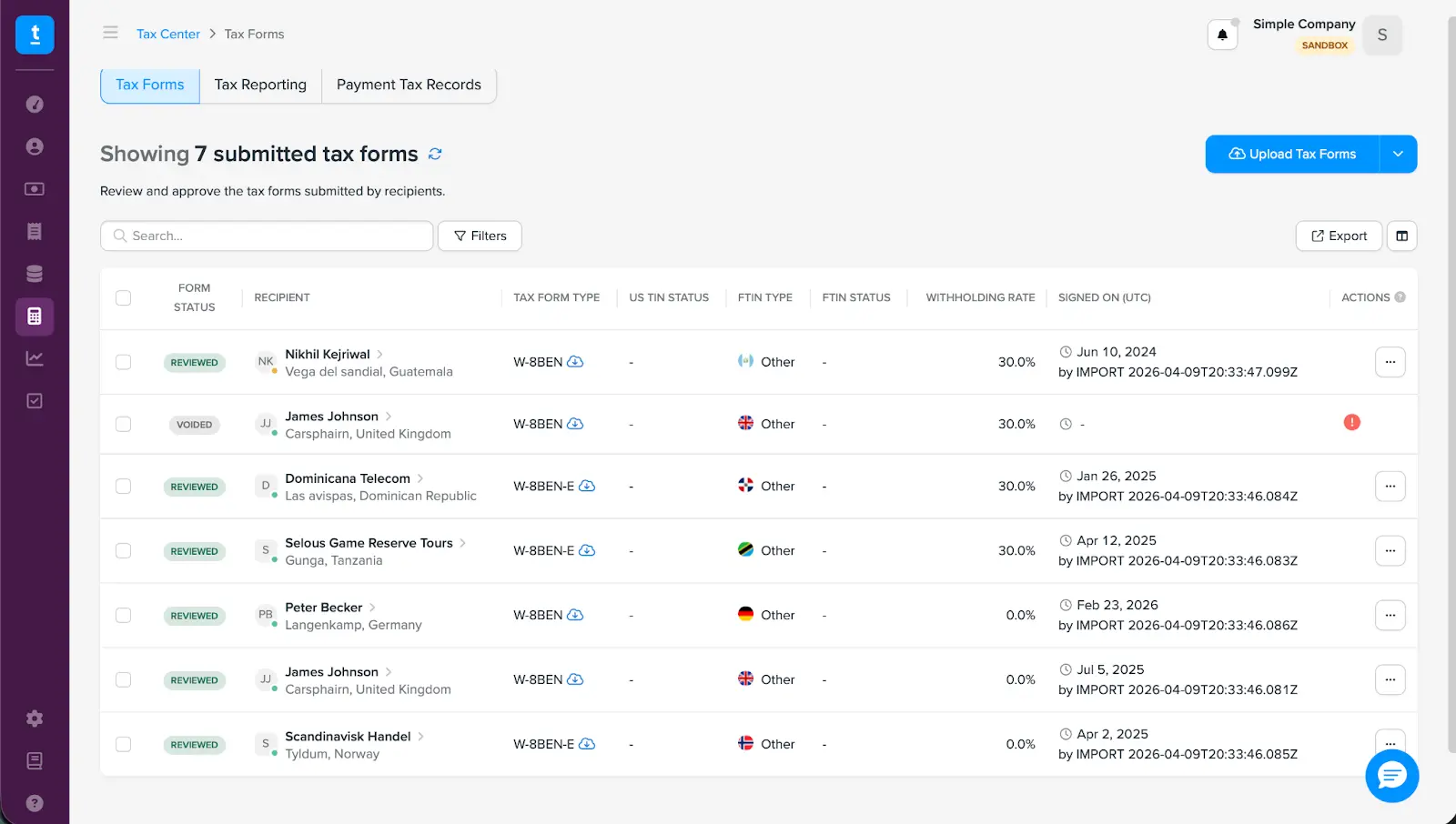
Trolley integrates tax compliance directly into the payout workflow. It supports W-8 and W-9 collection with validation, enables generation and e-filing of forms such as 1099 and 1042-S, and includes support for OECD digital platform reporting frameworks in the EU, UK, AUS, and NZ.
By consolidating these workflows, platforms can reduce administrative overhead and minimize compliance risk as they scale.
Trolley key feature 3: Creator onboarding and payout experience
The onboarding and payout experience directly impacts creator activation and satisfaction.
If payout setup is confusing, slow, or lacks transparency, it can delay earnings, increase support volume, and erode platform trust.
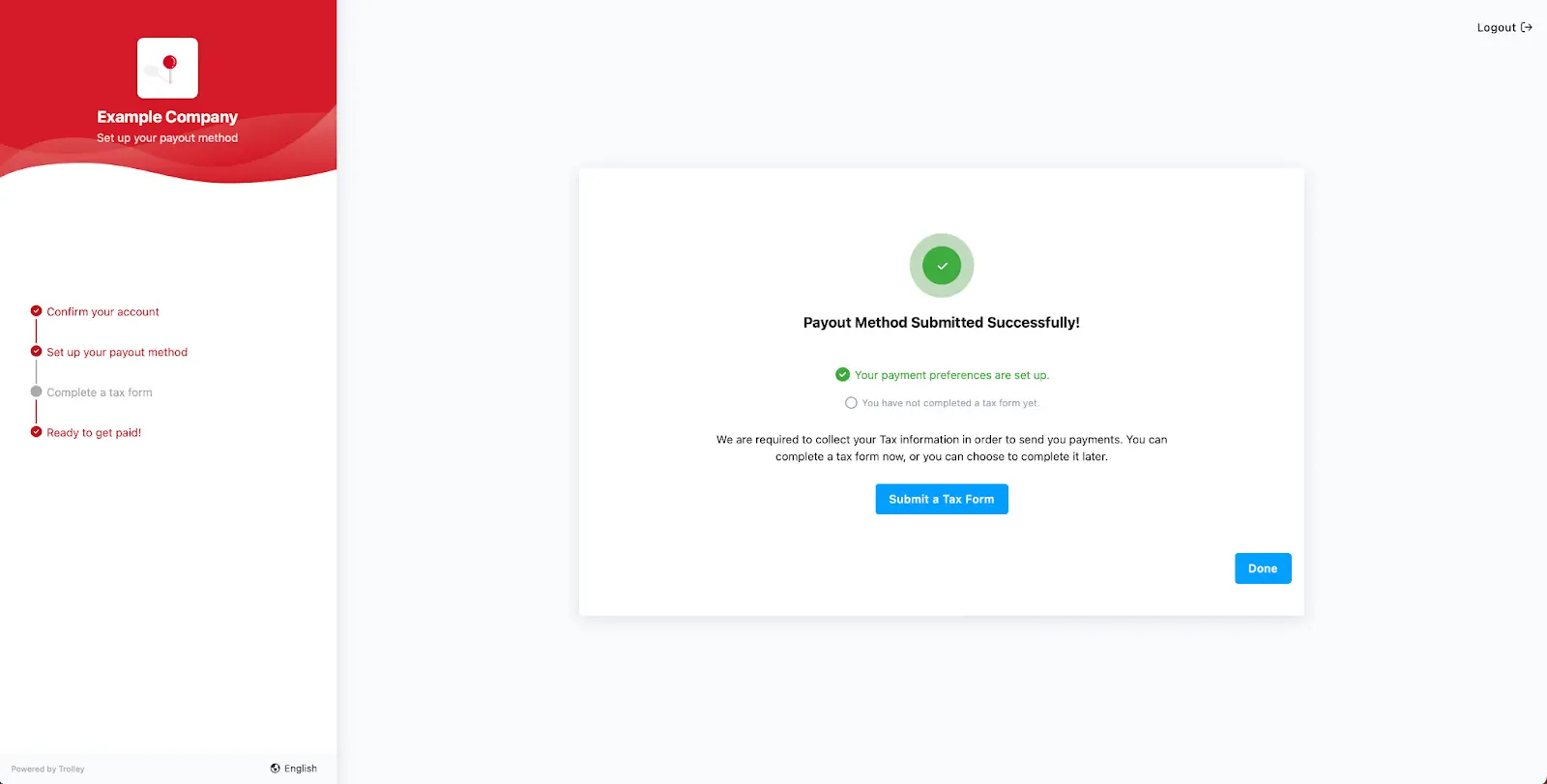
Trolley provides a white-label onboarding experience that can be embedded directly into your platform. Creators can manage their payout details, track payment status, and understand fees and timing within a branded interface.
With support for 36 languages and transparent FX handling, platforms can deliver a consistent experience across global creator networks.
For product-led creator businesses, this level of control over onboarding and payout UX can significantly improve activation rates and reduce friction.
Trolley key feature 4: Risk management and identity verification
As platforms scale, they face increasing risks related to fraud and compliance.
Incorrect payouts—whether due to duplicate accounts or fraudulent activity—can directly impact platform trust and create a burden for internal teams.
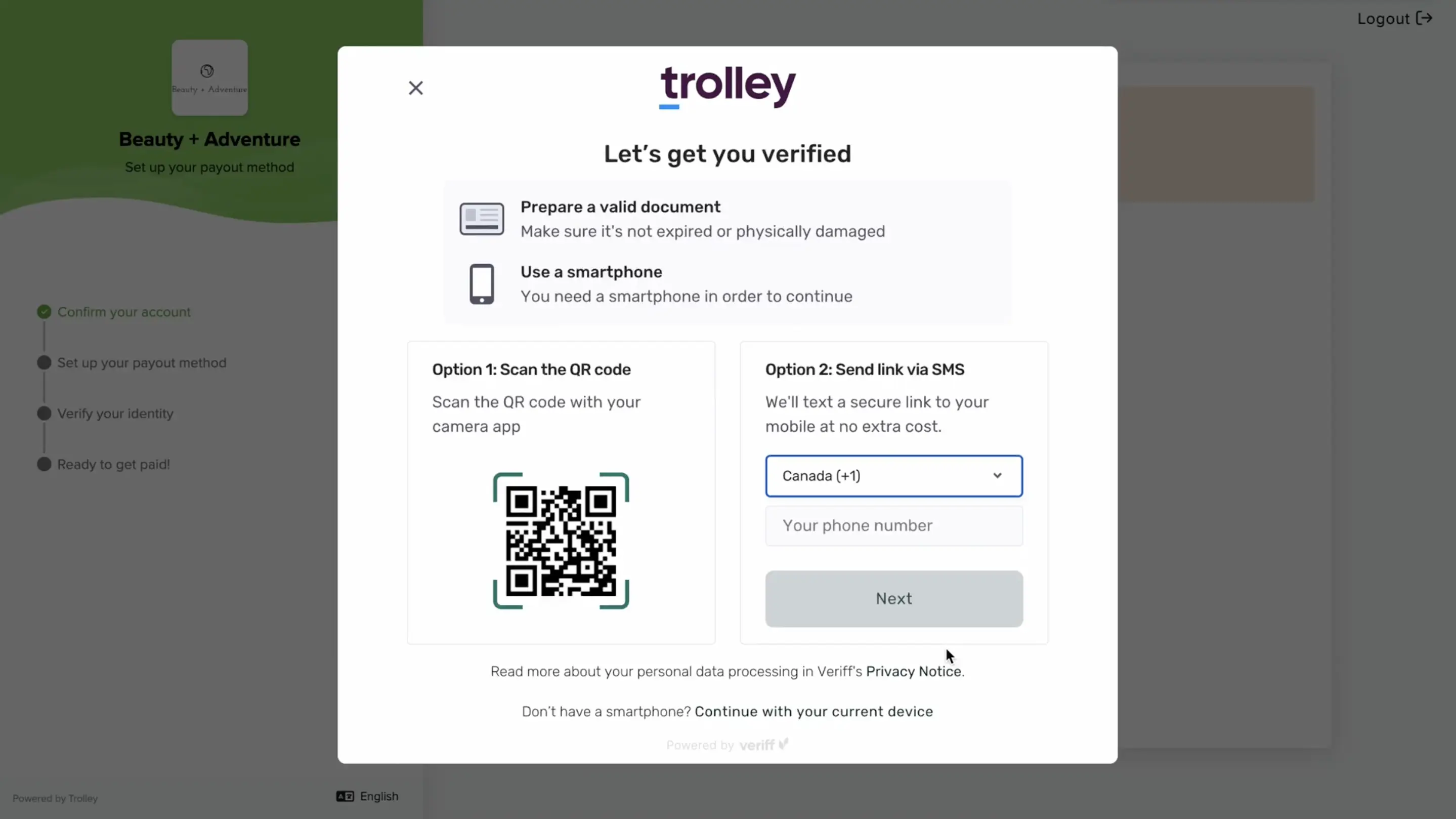
Trolley includes identity verification, watchlist screening, and risk monitoring tools designed for global payout environments. It supports verification across 200+ countries and territories and integrates risk signals directly into payout workflows.
This allows teams to detect suspicious activity earlier and prevent issues before funds are released.
For platforms paying creators, integrating risk controls into onboarding and payout operations helps maintain trust without introducing unnecessary friction for legitimate users.
Trolley key feature 5: Multi-entity support and flow of funds flexibility
Platforms paying creators often operate across multiple entities, partners, and intermediaries, requiring flexible control over how funds move through the ecosystem. In many cases, platforms need to support both in-flow and out-of-flow of funds models depending on regulatory requirements, partner relationships, or how revenue is structured.
Trolley supports multi-entity setups within a single account, allowing platforms to manage different regions, business units, or partner relationships centrally. It also supports both in-flow and out-of-flow of funds models, enabling platforms to adapt to complex payout scenarios such as multi-party relationships (e.g., agency → brand → creator) without restructuring their payout stack.
For creator platforms, this flexibility is critical as business models evolve. It allows teams to support more complex payout chains and regulatory requirements without rebuilding their infrastructure.
Stripe Connect overview
Stripe Connect is a payments and payouts infrastructure platform designed for businesses that want to manage payments, fund allocation, and payouts within a single system.
It is well-suited for platforms where monetization is tightly linked to transactions—such as subscriptions, tipping, or marketplaces—already being processed through Stripe.
Stripe Connect allows platforms to onboard creators as connected accounts, split payments, manage balances, and trigger payouts based on transaction activity and offers extensive API flexibility.
However, its architecture is centered on payments and connected accounts rather than payout operations. As a result, platforms with more complex global payout requirements—such as multi-source earnings, tax compliance across jurisdictions, or creator-facing payout UX—often need additional tooling or internal systems.
In practice, Stripe Connect is strongest when payouts are an extension of payment flows, rather than a standalone operational challenge.
Hyperwallet overview
Hyperwallet is a global payout platform focused on payment delivery and recipient cash-out experiences.
It enables businesses to send funds to payees worldwide and provides a hosted portal where recipients can select payout methods and withdraw funds. It is widely used by marketplaces and platforms that prioritize payout flexibility and recipient choice.
Hyperwallet supports a wide range of payout methods—including bank transfers, PayPal, Venmo, and other region-specific options—making it attractive for platforms with diverse global audiences.
However, Hyperwallet is primarily designed as a payout delivery layer. Key workflows such as onboarding, tax compliance, and payout orchestration often require additional systems or program configuration.
As platforms scale, this can introduce operational complexity, particularly when teams need more control over workflows or a unified system for payouts and compliance.
Feature-by-feature comparison
Payout orchestration and workflow flexibility
The biggest difference between these platforms is where payout logic lives.
Trolley is designed as an operational payout layer, allowing platforms to consolidate earnings from multiple sources and manage payouts through structured workflows, approvals, and batch processing.
Stripe Connect is strongest when payout logic is tied directly to Stripe-powered payment flows. It offers a lot of flexibility, but requires platforms to build around its connected-account and transaction model.
Hyperwallet relies on predefined payout programs. While it supports recurring and direct payouts, workflows are more structured and less flexible for dynamic, multi-source payout logic.
For creator platforms managing complex earnings models, this distinction becomes critical.
Global payout coverage and reliability
All three platforms support global payouts, but they approach coverage and delivery differently.
Trolley supports payouts to 210 countries and territories in 135 currencies, with a bank-first model complemented by methods such as PayPal and Venmo. It is designed for predictable delivery across regions and also supports instant payout options where available, giving creators more flexibility in how and when they get paid. Merchants can onboard in the US, UK, Canada, EU, Australia, and New Zealand, enabling platforms to operate across multiple entities globally.
Stripe Connect supports payouts to ~118 countries via its connected-account model, with broader reach available through other Stripe products. However, merchant onboarding is primarily limited to the US and UK, which can constrain how global platforms structure their operations. Currency support is broad, but varies by country, connected account type, and payout method rather than being a single universal set. In practice, this means you can only pay creators in countries where Stripe supports connected accounts, and the exact payout options depend on how your platform is structured (Standard, Express, or Custom accounts) and local banking capabilities.
Hyperwallet supports payouts to ~200 countries and territories and ~50+ currencies, with a wide range of payout methods including bank transfers, PayPal, Venmo, cards, and other region-specific options. However, availability varies significantly depending on program setup, payout model, and region.
For platforms prioritizing consistency, speed, and global reach, these differences can directly impact payout reliability and the overall creator experience.
Tax compliance and reporting
Tax compliance is one of the clearest areas of differentiation.
Trolley provides a fully integrated tax compliance stack, including W-8 and W-9 collection and validation, withholding logic, and generation and e-filing of 1099-NEC, 1099-MISC, 1099-K, and 1042-S. It also supports OECD digital platform reporting across the EU, UK, Australia, and New Zealand, bringing collection, reporting, and filing into the same workflow as payouts.
Stripe Connect offers strong US reporting, including 1099-NEC, 1099-MISC, and 1099-K for connected accounts, along with tax information collection and controls to prevent payouts when required data is missing. It also supports DAC7 reporting for Connect platforms. However, support for additional tax workflows—such as 1042-S reporting or broader international compliance—tends to be more limited or requires additional configuration and external tooling depending on the use case.
Hyperwallet supports tax collection and year-end workflows, including W-8/W-9 collection and 1099-NEC generation, with additional forms such as 1099-K, 1099-MISC, and 1042-S available through IRS Compliance workflows or add-on processes. Compared to Trolley, tax capabilities are more modular and often require additional setup or external coordination.
For businesses managing global creator payouts, the level of integration between payouts and tax workflows can significantly affect operational efficiency, reporting accuracy, and compliance risk.
Creator experience and onboarding
Each platform reflects a different philosophy around user experience, with meaningful differences in control, localization, and how creators interact with payouts.
Trolley prioritizes the recipient experience and provides a fully customizable, white-label onboarding flow. Platforms can embed onboarding directly into their product, control branding and flows, and allow creators to manage payout methods, tax information, and payment status in one place. Trolley supports 36 languages and includes transparent FX visibility, helping deliver a consistent global experience.
Stripe Connect treats creators as connected accounts within a payments ecosystem. It supports hosted, embedded, and API-based onboarding flows, with localized experiences depending on region. This model works well when creators are effectively sellers on the platform, but onboarding can feel heavier in payout-first use cases where creators primarily need to set up payment details and get paid.
Hyperwallet provides a hosted Pay Portal and embedded payout experiences, with 30+ supported languages and strong self-service capabilities. Creators can choose payout methods, manage transfer preferences, and initiate withdrawals depending on the program setup. However, the experience is more provider-controlled, and customization is more limited compared to fully white-label approaches.
For creator platforms, the level of control over onboarding, localization, and payout visibility can directly impact activation speed, support volume, and long-term retention.
Risk management and identity verification
All three platforms provide compliance and verification capabilities, but they differ in depth, flexibility, and how tightly risk controls are integrated into payout workflows.
Trolley combines KYC/KYB, identity verification, AML/sanctions screening, and ongoing monitoring into a unified payout operations layer. It supports verification across 200+ countries and territories, validates government-issued IDs, and applies payout controls such as blocking or holding payments until required checks are completed. Risk signals (e.g., changes to payout details or suspicious activity) can trigger reverification or manual review before funds are released.
Stripe Connect provides KYC/KYB and AML/sanctions screening through its connected-account model, with additional tools like Stripe Identity for document verification. Compliance checks are tied to account onboarding and maintenance, with reverification triggered by profile changes or regulatory requirements. This model is strong for verifying individual creator accounts, but those checks are tightly tied to Stripe’s account and payments system rather than operating as a standalone payout operations layer.
Hyperwallet includes payee verification, AML/sanctions screening, and compliance checks across its payout programs. It supports identity validation and reverification when account details change, but review processes are often provider-managed and may require manual intervention, which can introduce delays in certain cases.
For creator platforms operating at scale, the ability to integrate verification, monitoring, and payout controls into a single workflow can reduce fraud risk, improve compliance, and maintain trust without introducing unnecessary friction for legitimate users.
Pros and cons
Trolley
Pros
- Purpose-built for creator payout operations
- Strong global tax compliance and reporting
- Customizable, white-label onboarding experience
- Well-suited for multi-source payout workflows
Cons
- Not designed as a full payments/acquiring platform
- Payout method coverage can be less extensive than Hyperwallet in specific regions or edge-case scenarios
- No native creator “cash-out” model by default
Stripe Connect
Pros
- Highly flexible API and funds flow control
- Strong fit for transaction-based creator platforms
- Extensive developer tooling and ecosystem
- Mature US tax reporting workflows
Cons
- Can be engineering-heavy for payout-first use cases
- Creator onboarding is more seller-oriented
- Additional tooling often needed for global tax and payout ops
Hyperwallet
Pros
- Strong payout delivery and recipient experience
- Broad range of payout methods globally
- Good fit for payout distribution use cases
- Localized payee experience
Cons
- More program- and provider-dependent
- Less unified tax and compliance workflows
- Limited control over payout operations
- Less transparent fee structures
Which platform should you choose?
The right platform depends on how your creator business operates and where complexity sits in your workflow.
Stripe Connect is typically the best fit for platforms where payouts are tightly coupled to payment flows. If your business is built around transactions, take rates, and connected accounts, Stripe offers the most flexibility.
Hyperwallet is a strong choice when the primary goal is delivering payouts to creators through a wide range of methods with a hosted, self-serve experience.
Trolley is best suited for platforms where the core challenge is managing global creator payouts—onboarding, tax compliance, payout workflows, and recipient experience—within a single system.
For most creator platforms, the key decision factors come down to control, scalability, and how tightly payouts need to integrate with payments versus operating as a standalone workflow.
FAQs
What is the main difference between Trolley, Stripe Connect, and Hyperwallet?
Stripe Connect focuses on payments and payouts infrastructure, Hyperwallet focuses on payout delivery, and Trolley focuses on payout operations, onboarding, and tax compliance.
Which platform is best for paying creators globally?
Trolley is typically the strongest option for payout-first use cases, particularly for platforms that need multi-entity support, to onboard large numbers of creators, consolidate earnings from multiple sources, and handle global tax compliance and reporting within a single, centralized system. Hyperwallet is strong for payout method flexibility, while Stripe Connect works best when payouts are tied to payment flows.
Does Stripe Connect support tax reporting for creator platforms?
Yes. Stripe supports US 1099 reporting and offers platform-level tax reporting for regulations like DAC7, though its tax capabilities are more closely tied to its payments infrastructure.
Is Hyperwallet a good fit for creator platforms?
Yes, particularly for payout delivery and recipient choice. However, it may require additional systems for onboarding, tax compliance, and workflow management.
What makes Trolley different for creator businesses?
Trolley combines payout execution, onboarding, tax compliance, and reporting into a single system, making it well-suited for platforms paying large global networks of creators.