







The start of a new business relationship with contractors should be exciting for both parties. Often, however, it’s dragged down by the tedious work of completing and submitting the necessary forms, like Form W-9.
Collecting Form W-9 during contractor onboarding ensures your business has the information it needs to maintain and prove compliance in the tax season. But processes that rely on paper or PDFs and emails to collect these forms are showing cracks.
Manual processes leave room for human errors that can be costly down the line. Plus, sending sensitive data like Social Security Numbers (SSNs) over email is risky for both you and your contractors. Missed or displaced information complicates compliance and strains teams. It also impacts your relationships with freelancers and gig workers. Instead of getting onboarded quickly and jumping to their first projects and gigs, freelancers and contractors often experience operational delays that make them wait for work and, consequently, payment.
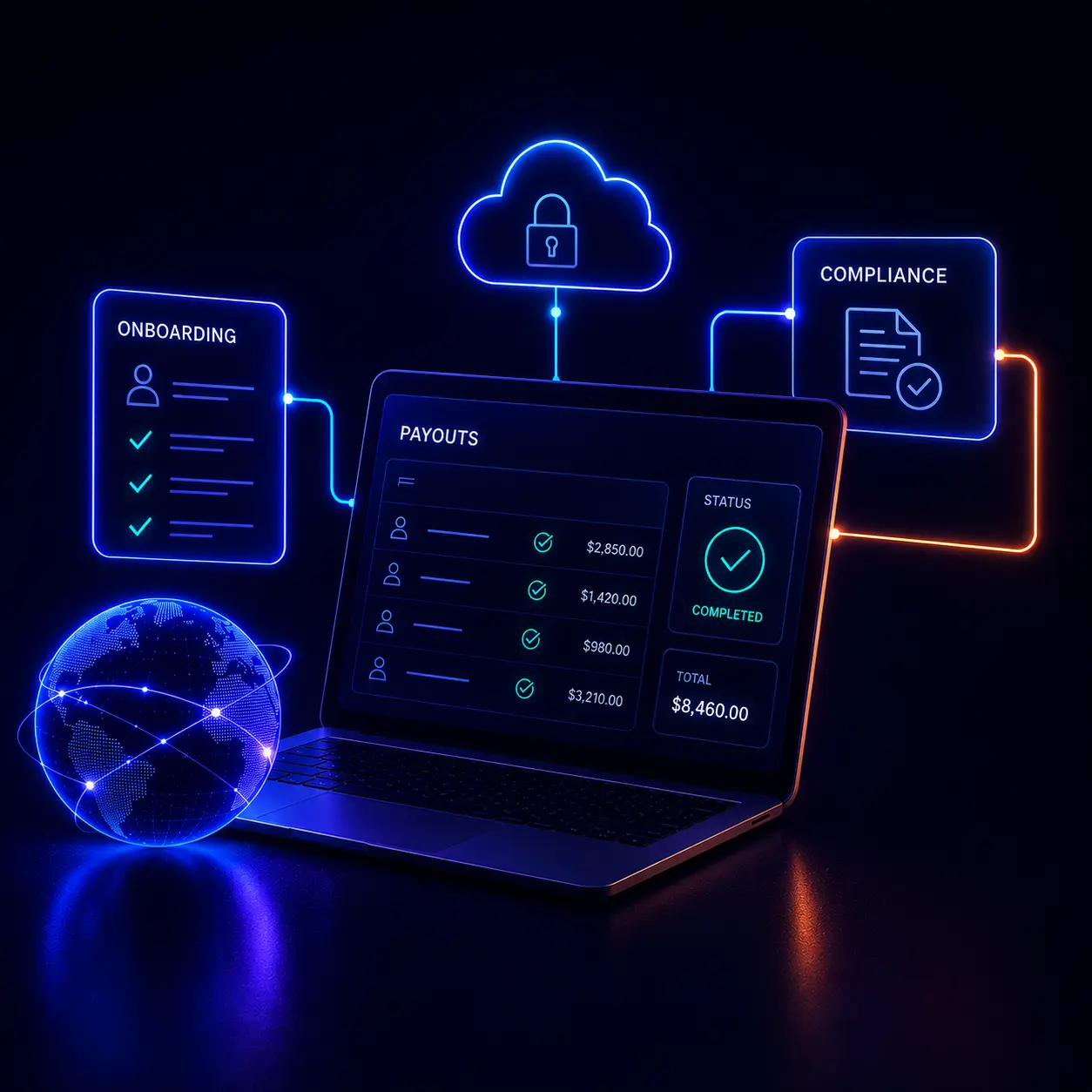
Automating contractor onboarding and form collection removes these points of friction, providing freelancers and contractors with a smoother, more convenient way to fill out their forms and get paid. This improves their satisfaction with your platform and keeps them coming back instead of looking for alternatives.
But before you automate your processes, take a moment to learn what Form W-9 is, why it exists, what it’s used for, and when you need it, so you can make informed decisions about onboarding your growing number of freelancers and contractors.
What we cover
- Understanding the purpose of IRS Form W-9
- Who needs to complete a W-9 form?
- Why businesses collect taxpayer identification numbers
- Simplify W-9 collection during contractor onboarding
- Best practices for managing and updating W-9 records
- Digital W-9 collection and automated compliance workflows
- W-9 vs. W-8: Understanding the difference for global payouts
- Simplifying contractor tax compliance with modern payout infrastructure

Understanding the purpose of IRS Form W-9
IRS Form W-9 is the Request for Taxpayer Identification Number and Certification form. If you expect to pay a freelancer or contractor $600 or more over the year, the payee needs to complete this form to provide you with their tax information. The W-9 form includes details like the contractor’s individual name, business name, address, and taxpayer identification number (TIN).
Contractors fill out these details and the other fields in the W-9 form, then send the completed form back to you. The form never goes to the IRS. Instead, your business uses the information from the W-9 form to file relevant Forms 1099 with the IRS, which are used to report contractor income and other payments like rent or royalties.
If any of the information submitted on a 1099 is incorrect, you (as the filer) may face fines, and the contractor’s income could become subject to backup withholding of 24% on any future payments. Now, imagine a freelancer or gig worker learning that you need to withhold a part of their hard-earned income.
That’s what makes correct and swift Form W-9 completion so important. Do it wrong, and you risk damaging your bottom line and your contractors losing trust in you.
Who needs to complete a W-9 form?
Generally, businesses should request Form W-9 from any contractors they expect to pay $600 or more over the year. The following non-employees are the types of individuals/entities who should complete a W-9 before being paid:
- Freelancers
- Sole proprietors
- Vendors
- Limited Liability Corporations (LLCs)
- Other US-based payees
If your business exchanges goods or services with another organization in a barter worth $600 or more, you should also collect a W-9 form. You’ll need the information from Form W-9 to file the required Form 1099-MISC during tax season.
Salaried employees, however, do not need to fill out Form W-9. They instead complete Form W-4 to provide their personal information and tell their employer how much federal income tax to withhold from their paychecks.
Breaking down the main sections of a W-9 form
At the top of a W-9 form, there’s space for the payee to fill out personal and business details, including:
- Individual/entity name
- Business name
- Business classification (e.g., Sole proprietor, C corporation, or S corporation)
- Address
- Applicable exemptions
If you already have these details for the contractor, you can pre-fill them to make it easier for them to complete the form. If so, the contractor is responsible for verifying that all the information included in the form is accurate and up to date.
In Part I of Form W-9, the contractor fills out their Taxpayer Identification Number (TIN). Individuals generally use their SSN as their TIN, while businesses may use an employer identification number (EIN) instead.
In Part II, the person filling out the form certifies that everything on the form is correct. They sign and date the form to finish it.
Note: Form W-9 does not need to be notarized.
Why businesses collect taxpayer identification numbers
When your business pays contractors or other non-employees more than $600 in a year, you have to file Form 1099 with the IRS to report those payments. One of the most important pieces of information you must include on that form is the recipient’s TIN, which you get from their Form W-9.
The IRS uses taxpayer identification numbers as a unique identifier to keep track of individuals and entities with tax obligations. Anyone filing tax forms with the IRS must use a TIN, so the IRS knows who/which entities are involved in the relevant transactions.
The best practice is to request Form W-9 before the first payment for any contractor you expect to pay $600 or more over the year. Having the form in hand will save you time when filling out Form 1099 later on and reduce the risk of making a mistake or running into compliance issues. You also need W-9 information that certifies the payee is not subject to withholding, so you can avoid backup withholding penalties.
Whether you will receive an SSN or an EIN as the payee’s TIN depends on the structure of their business. Sole proprietorships, freelancers, and single-member LLCs may use their personal SSN as their TIN, while partnerships, multi-member LLCs, and corporations must use their EIN.
Even if the form provider uses an EIN on Form W-9, they must provide their legal personal name on Line 1 of the form.
Note: Verify that the details in the form match your existing records for the individual/entity.
Simplify W-9 collection during contractor onboarding
With the quick pace required in growing freelance and gig economy platforms, you really can’t afford a disjointed, disorganized onboarding process. The gig economy is already hard enough for the workers, with unpredictable payments and fees making financial planning increasingly challenging. If you’re adding a demanding onboarding process and heavy compliance checks to this experience, workers may immediately seek a more streamlined alternative.
Simplifying the onboarding and form completion processes means you can get new contractors up and running fast. You eliminate the friction and risk of having to send sensitive documents back and forth over email. Contractors can start working and get paid faster, which adds to their financial stability and increases trust in your platform. In turn, you improve your retention rates and save time and resources on W-9 collection without increasing compliance risks.
Delayed or incomplete W-9 collection may lead to problems down the line. If you reach the 1099 filing season but don’t have a contractor’s TIN, your accounting team will be left scrambling to get it before you can submit to the IRS. If you’re unable to file Form 1099 on time, you also face penalties from the IRS of $60 to $680 per information return or payee statement. You want to avoid putting that kind of stress and friction on your employees.
Best practices for managing and updating W-9 records
Inaccuracies or late filing of Form 1099 can lead to fines for your business and tax withholdings for your contractors, impacting both your bottom line and retention. That’s why you need to ensure that all the information on your contractors’ Forms W-9 is correct and up to date before you complete and file Form 1099.
If your contractors don’t provide you with an accurate TIN on Form W-9 as requested, they become subject to the backup withholding “B” program. You then send them a “B” notice. To stop the backup withholding, the contractor must send you the correct TIN on a signed Form W-9.
These best practices can help you improve your W-9 collection and maintenance and avoid compliance issues and damaged relationships:
- Use secure storage: Keep completed W-9s in a secure digital location with backups to protect your contractors’ sensitive information.
- Request updates: Ask for an updated W-9 after an entity or contractor changes any important piece of information on the form, from the address to the business name.
- Maintain audit trails: Record timestamps of when you collected the completed W-9 and any changes made to it for at least four years after your last payment to the vendor in case of audits.
An automated tax workflow helps eliminate many of the bottlenecks and potential pitfalls in collecting forms from your payees. The easier it is to collect, verify, and store each individual or entity’s tax forms, the smoother the tax season will be. Automated systems reduce manual errors and improve payout compliance while managing a growing network of gig workers and contractors.
Protecting sensitive taxpayer information during W-9 collection
Form W-9 includes sensitive information from contractors, such as their address and Social Security number or EIN. It’s your business’s responsibility to protect that information.
Try to collect the completed form through secure channels, like a trustworthy contractor payout platform.
Note: Don’t let just anyone in your organization access the forms—restrict access to the employees who actually need the information.
Keep an eye out for phishing scams, where cybercriminals impersonate a trusted organization to get people to give up sensitive information. Remind your contractors to always double-check requests for W-9 completion and explain how to verify that the one you send is legitimate.
Digital W-9 collection and automated compliance workflows
The old way of collecting W-9s involved paper, PDFs, countless emails back and forth, uploads, and manual storage of the forms on your end. While these processes can work while a company is small, they can create more room for error, especially as you scale. For instance, you could lose the payee’s completed form or accidentally upload the wrong form for the contractor.
Digitizing your W-9 processes reduces these risks. A contractor payout platform like Trolley uses substitute digital tax forms. When signed in to the portal, contractors are guided through submitting their payment and tax data. The software also collects a digital signature, eliminating the need for hard copies and scanning or even secondary signature tools. Before form submission, Trolley issues alerts for potentially incorrectly completed forms, such as inconsistent address details.
The result is an automated, streamlined process that’s more convenient for you and your contractors. The contractors don’t have to wonder what they need to submit or where, and you don’t have to worry about misplacing information when onboarding new freelancers or gig workers.
W-9 vs. W-8: Understanding the difference for global payouts
The W-9 form for independent contractors is strictly for US persons. If the individual or entity you’re paying does not have a US TIN, you need to use Form W-8 for non-U.S. persons and businesses.
If you’re collecting these forms manually, you have to decide which form to use with each business or entity you’re paying, but that’s not the case with Trolley. One of Trolley’s tax features is a digital Wizard that helps contractors and other payees decide which tax form they may need to complete, Form W-9 or W-8, depending on their location.
Simplifying contractor tax compliance with modern payout infrastructure
Onboarding contractors involves many small tasks that can quickly become time and resource-intensive, especially as you expand your network of contractors and need to manage payouts for all of them. Collecting W-9 forms is just one of the necessary steps that, if handled poorly, can create friction that weakens your relationship with contractors.
Automating payouts and compliance helps you simplify onboarding for both your internal teams and freelancers or gig workers. For contractors, automation reduces wait times and frustrating back-and-forth with support. For your business, it eliminates compliance risks and extra costs associated with incorrect form and payment completion, and poor contractor experience.
Book a demo to see how Trolley removes manual work, simplifies end-to-end payouts, and streamlines compliance through one comprehensive modern payout infrastructure.