








As part of our raising the bar updates, we’re introducing faster payout methods, including debit card and mobile wallet payouts.
This post covers how pricing for those methods works—what the fees are, how they’re calculated, and how you can configure who pays.
Pricing for instant payouts is built around a simple percent-based model that keeps fees predictable while giving you flexibility in how they are applied. You can pass fees to recipients, split them, or absorb them entirely, depending on your business model.
The structure is intentionally clear. Bank transfers remain the baseline for cost efficiency, while for faster methods, we charge a percentage-based fee. That clarity helps recipients make informed choices and reduces confusion around fees.
What we cover
Faster payouts, with clear and predictable pricing
Debit card and mobile wallet payouts give recipients faster ways to access funds—often instantly—using methods they already rely on. Debit cards provide near-instant delivery to US recipients with eligible Visa and Mastercard cards, while wallets enable fast, reliable payouts across global, wallet-first markets.
Regardless of method, pricing follows the same percent-based model below.
The model is simple:
- 1% of the sent amount
- Calculated after tax withholding, if applicable
- Minimum fee of 1.50 USD for debit card payouts
- Minimum fee of 4.00 USD / 4.00 EUR / 5.00 CAD / 5.00 AUD / 3.50 GBP for international card and wallet payouts, plus applicable FX fees
This creates a consistent, easy-to-understand baseline for both merchants and recipients.
For Trolley Plus customers, revenue share is available on these payout methods—reach out to learn more about revenue share options.
Keep bank transfers as your baseline
While we are introducing faster payout options, consistency and predictability matter.
Bank transfers provide a familiar baseline for recipients. It’s typically the lowest-cost option available and sets cost expectations for what standard payouts look like.
From there, faster payout methods can be introduced as additional options that recipients can choose based on their preferences for speed and delivery method. While the recipient experience may vary depending on the method (for example, wallets vs. cards), the key difference is that faster delivery comes with a transparent fee.
Internally, these methods follow a similar operational flow, but with a different fee structure that reflects the speed of expedited payments. This makes the choice clearer for recipients while keeping things consistent for your team.
Flexible fee allocation: decide who pays for speed
Payout fee preferences can vary depending on your business model, recipient relationships, and overall payout experience. Instant payout pricing gives you the flexibility to allocate fees in the way that makes the most sense.
There are three ways you can configure fee allocation:
Pass fees to recipients
Recipients pay the fee associated with the faster payout method they select.
This works well when:
- Recipients already pay fees for bank transfers today
- You want to keep merchant costs stable
- You want to clearly position speed as a premium option
For affiliate networks, ad networks, or gig platforms where payouts are frequent and recipients already expect a standard option alongside premium upgrades, this may be a good option. In these cases, speed becomes an optional convenience rather than a default expectation.
Split fees between merchant and recipient
Fees can be shared in a way that balances cost and experience.
You can:
- Split fees by percentage
- Split fees by a fixed amount
- Set a maximum amount the merchant will cover
This allows you to support faster payouts while keeping costs predictable, especially when scaling across large recipient bases.
Marketplaces and creator platforms that want to balance cost control with a strong recipient experience may want to choose this option. For example, a marketplace paying sellers or a platform paying creators may choose to cover what they already contribute on bank transfers, while allowing recipients to pay the incremental cost for faster access.
Merchant covers fees
You can choose to absorb the full fee so recipients receive the full payout amount.
This is often used when:
- Recipient experience is a priority
- You want to remove friction entirely
- You’re competing on payout speed and simplicity
This approach is typically used in higher-touch environments, such as enterprise platforms, financial services products, or platforms competing aggressively on user experience. In these cases, removing fees entirely can improve retention, reduce friction, and serve as a meaningful competitive advantage.
How to keep your policy consistent
The simplest way to introduce faster payout methods is to anchor everything to your existing bank transfer policy.
A few practical rules of thumb:
- If you pass fees to recipients for bank transfers, keep pass-through consistent for faster methods
- If you split or cover fees for bank transfers, apply the same structure to faster methods
- If you use a coverage cap, keep it aligned with what you already cover for bank transfers
In this model, recipients pay only the incremental premium for choosing speed beyond what the merchant already covers. You can also, of course, choose to cover the full cost of the fee for your recipients.
This keeps your policy consistent and easier to explain.
How it fits into your existing workflow
Percent-based pricing is designed to work within your existing payout setup.
You can configure:
- Fee allocation (pass-through, split, or covered)
- Percentage or fixed coverage
- Maximum coverage caps
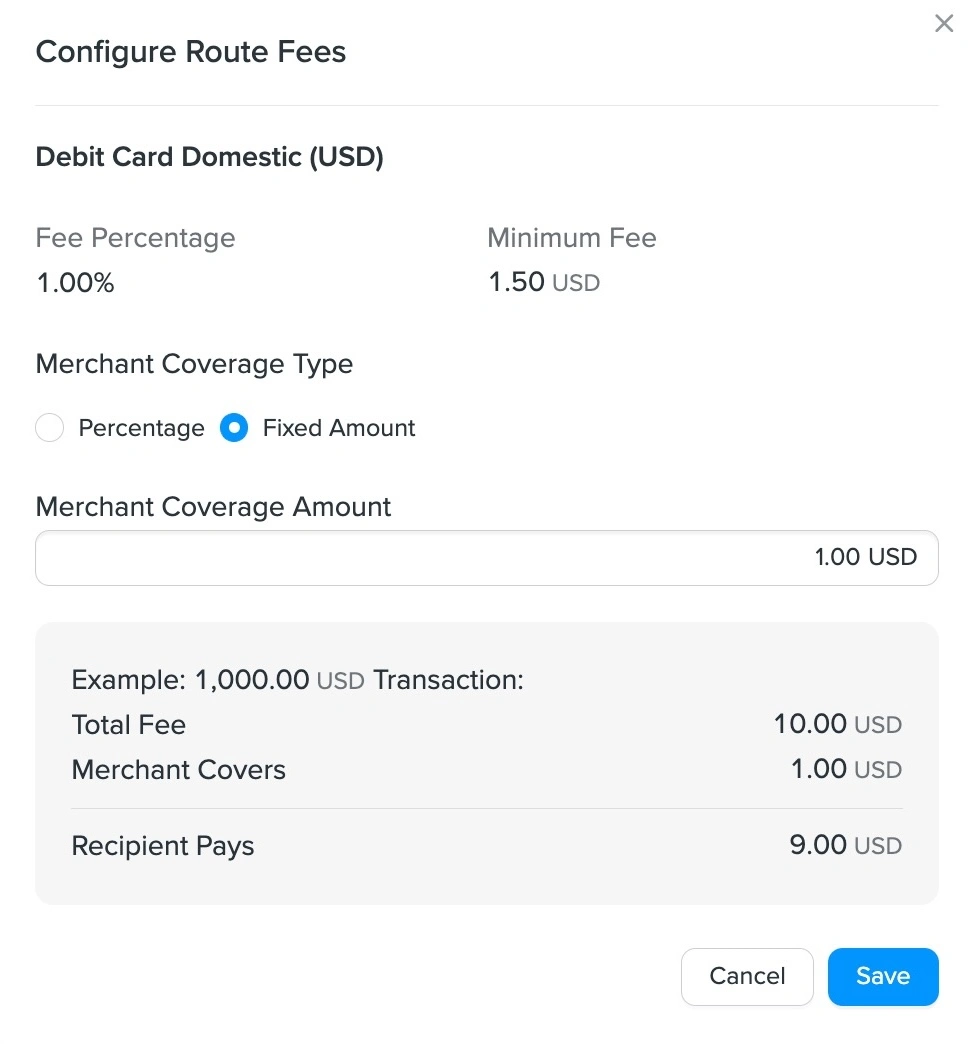
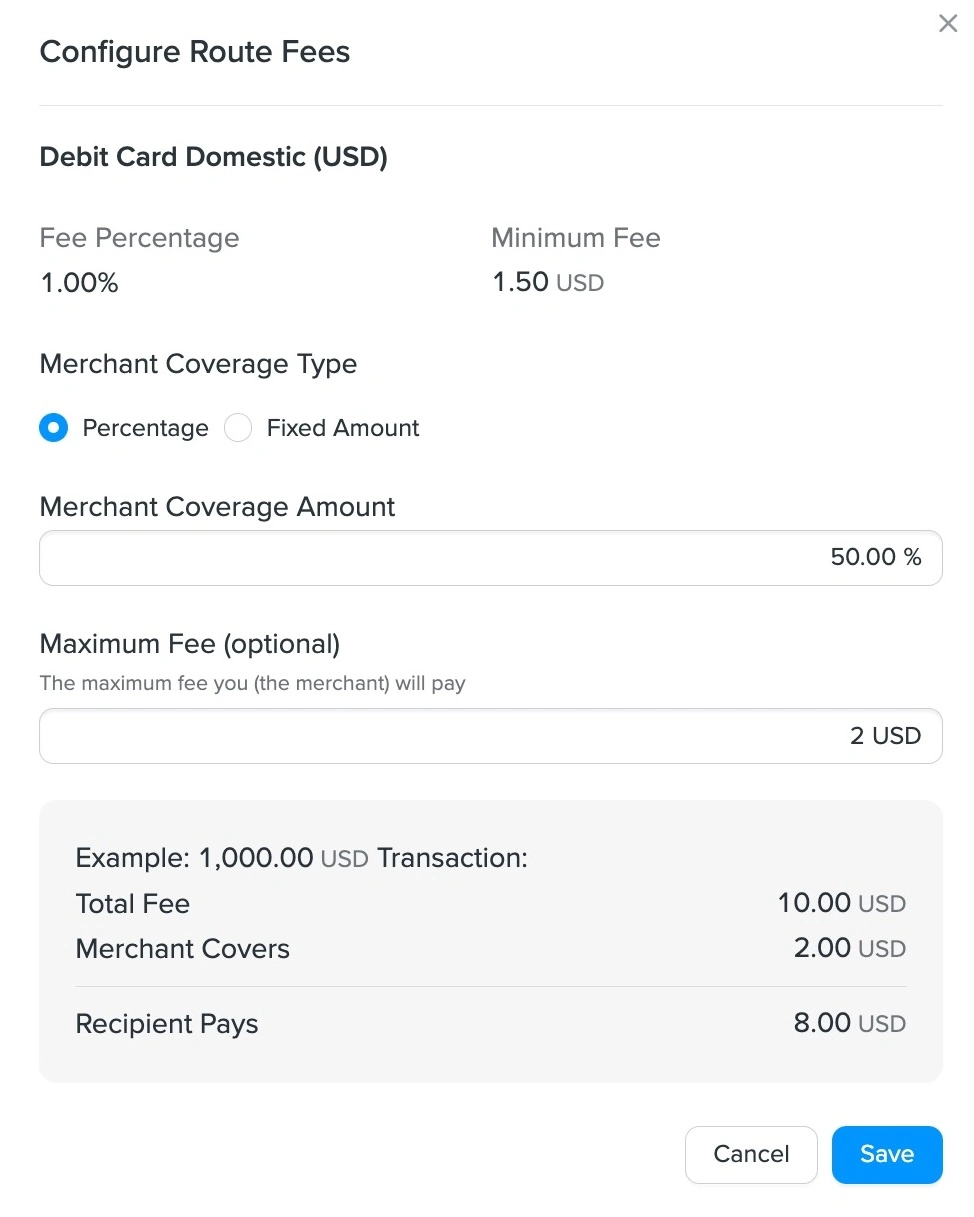
From a payout perspective, funds still come from your Trolley balance, payout workflows remain unchanged, and fee handling is applied automatically based on your configuration.
For recipients, fee visibility is built into the payout experience, so they understand costs before selecting a method.
Get started
To configure pricing for faster/instant payout methods, go to your dashboard and navigate to Settings → Fee Schedule. From there, you can define how fees are calculated, who pays them, and when any caps or minimums apply.
Once configured, your policy will apply consistently across payout methods.
For more detailed guidance, you can refer to our help documentation to review the full breakdown of fees and reconciliation for debit card payouts.
Offer speed on your terms
Faster payouts are increasingly expected, but how you price and manage them should still fit your business.
With percent-based pricing and flexible fee allocation, you can offer recipients faster delivery options while keeping costs predictable, policies consistent, and recipient expectations clear.
Explore other new releases to see how we’re continuing to improve payouts across speed, flexibility, and control.