


Gig workers often need to pay for gas and supplies on a daily basis, so they expect their earnings soon after each job. Many platforms still pay out once a week by bank transfer, so workers have to cover daily costs for days before their money arrives. Instant payouts for gig workers can shorten the wait to minutes, but only if you can pay each worker through a method that’s fast in their country. Use this benchmark to see which payout methods process pay in minutes and what slows the rest down before you choose a provider.
What we cover
- Instant, same-day, and standard payouts: what the terms mean
- Payout speeds by method: a side-by-side benchmark
- How payout speed changes by region
- What slows a payout down
- Weigh payout speed against cost, risk, and scheduling
- Questions to ask any instant payout provider
- Offer faster payouts without adding operational work
Instant, same-day, and standard payouts: what the terms mean
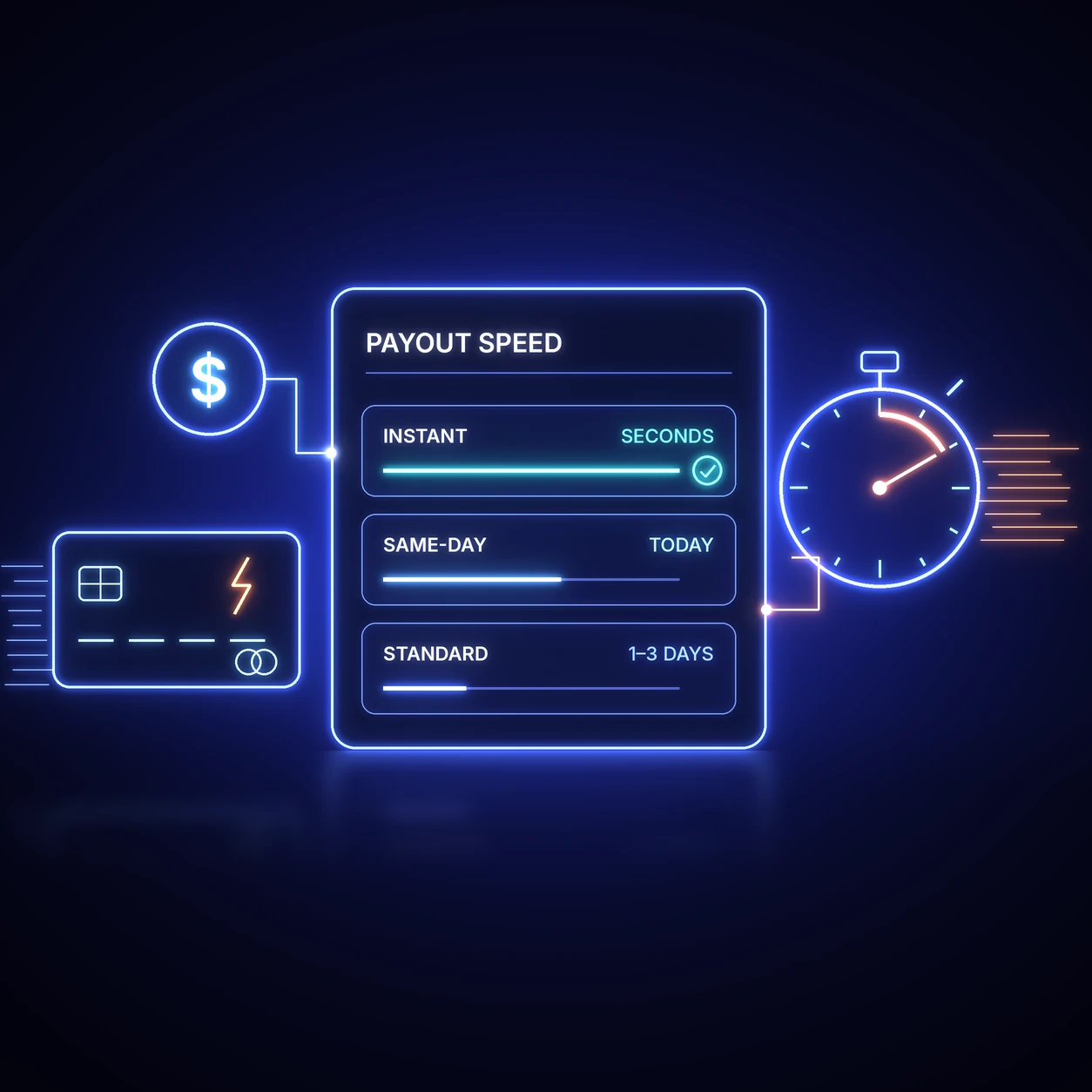
An instant payout gets to the worker within seconds or minutes, at any hour, through debit card networks or real-time payment systems like FedNow. Same-day ACH is slower but still arrives the same business day. It uses the Automated Clearing House (ACH) network, and the money is available to the worker that day as long as the platform’s bank submits the payout before the network’s final 4:45 p.m. Eastern deadline. A standard payout, like a regular ACH transfer, usually arrives in the worker’s account within one to three business days.
Payout speeds by method: a side-by-side benchmark
Card networks and real-time bank networks operate 24 hours a day, so a payout sent through them can reach a worker within minutes any day of the week. ACH runs only on business days, so a batch sent on Saturday won’t be processed until Monday. Speed is one factor in how ACH, wire, and PayPal transfers compare, along with cost and reach.
Instant payout providers usually send money over the same card networks and real-time bank networks, which is why their speeds look alike. Most push-to-card payouts arrive within 30 minutes, and because those networks never close, they go out on nights and weekends too.
Here’s how the main methods compare. Only the first three run 24/7, and workers need an eligible card or account to receive them:
| Method | Typical speed | Availability | Best for | Watch-outs |
| Push-to-card payouts | Seconds to 30 minutes on eligible debit cards | 24/7 | Cash-outs right after a job | Only eligible debit and prepaid cards receive them |
| Digital wallets | Minutes to the wallet balance | 24/7 | Workers who already use PayPal, Venmo, or a local wallet | Moving money to a bank account takes longer |
| Instant bank rails (RTP and FedNow) | Seconds | 24/7 | Larger payouts to US bank accounts | The worker’s bank has to be on the network |
| Same-day ACH | Same business day | Business days only | Scheduled daily batches | Anything sent after the final deadline arrives the next business day |
| Standard ACH | One or three business days | Business days only | Weekly batches with flexible timing | A Friday batch usually arrives the following week |
| International bank transfers | Usually several business days | Varies by country | Workers without a faster local method | Intermediary banks can deduct fees and add delays |
How payout speed changes by region
No single payout method works for every worker on a global platform. The method that pays a worker in seconds in one country might not exist in another, so start by looking at where your recipients are and support the payment methods that are most popular in each of those countries to pay everyone quickly.
Your cross-border payouts arrive fastest when you send them through each market’s leading local option:
- United States: Workers can receive debit card payouts and digital wallet payouts through PayPal or Venmo within minutes. Bank payouts over RTP or FedNow arrive in seconds, though only if the worker’s bank has joined one of those networks.
- UK and Europe: UK banks send instant payouts over Faster Payments. Euro-area banks send them as instant transfers, which EU rules have required them to support since October 2025.
- Latin America: Mexican banks settle transfers in seconds any time over SPEI, which is Mexico’s central bank’s processing system. In Brazil, the central bank’s Pix system completes transfers within 10 seconds.
- Sub-Saharan Africa: The region has the highest mobile money use in the world, so mobile money payouts to services like MTN MoMo are often the fastest way to pay workers here.
What slows a payout down
Four delays can hold up even an instant payout, though you can shorten or prevent most of them:
- Network schedules: Payout rails that operate only on business days pause on weekends or bank holidays. A same-day ACH payout sent after Friday’s deadline wouldn’t arrive until Monday, or Tuesday if Monday was a holiday. You can offer debit card payouts to workers who need money instantly.
- Identity and tax checks: Your platform needs to run identity verification before payouts go out to prevent fraud, so a worker who doesn’t do it at signup will have to wait longer for their first payout. You may also hold payouts until a US worker submits a Form W-9, since you’ll need it to file a Form 1099-NEC for anyone you pay $2,000 or more starting in 2026.
- Bank cutoff times: Your bank sets its own same-day ACH cutoff ahead of the network’s final deadline, so a batch submitted at noon could still miss it. Schedule batches in the morning to leave a buffer.
- Funding times: Your provider can only send payouts after your platform’s money has arrived in its account. Funding each batch by ACH adds a business day, which you can remove by keeping a prefunded balance with your provider.
Weigh payout speed against cost, risk, and scheduling
Instant payouts cost more to send than ACH, so your platform has to decide who covers the instant payout fees. DoorDash, for example, charges drivers a $1.99 fee per Fast Pay cash-out. A flat fee like that hits hardest on small payouts. In a simple example, a $2 fee takes 5% of a $40 payout but only 0.5% of a $400 one. Check your average payout size along with how pricing works for faster payouts, since a percentage fee will cost workers less on small cash-outs.
Speed also removes your chance to stop a bad payout, since instant transfers usually can’t be reversed. DoorDash blocks Fast Pay for seven days after a driver changes their debit card, so a scammer who logs into a driver’s account can’t swap in their own card and cash out the same day.
You don’t have to pay every worker instantly. Those who want cash after each job can use on-demand pay, while everyone else gets a free weekly batch that your team has time to review before it goes out.
Questions to ask any instant payout provider
Speed is only one part of choosing the right global payout platform, whether that’s a dedicated payout provider or the payment gateway you already use. Ask any instant payout software vendor these five questions, since each one covers a step that can delay a payout or add to its cost:
- Which payout methods can our workers receive in each country where they operate?
- How early do we need to fund a batch to make your cutoff?
- Do you verify identities and collect tax forms before the first payout?
- What do you charge per instant payout, including currency conversion?
- Can our engineers trigger payouts through your payouts API and match each one to our records?
Offer faster payouts without adding operational work
Trolley is payout infrastructure for platforms that pay gig workers, so your team can send faster payouts without managing each payout method separately. Our instant payout options include direct-to-debit card payouts in the US and digital wallet payouts in 32 countries, with identity and tax checks before and payout reconciliation after each payout. Book a demo to see how your workers can get paid faster without adding work to your team.